Showing posts with label Great Continental Railway Journeys. Show all posts

Thursday, 26 November 2015

Great Continental Railway Journeys: Freiburg to Hannover

German Romantic poetry 
Michael Portillo arrives in Freiburg liked the well-heeled public school boy that he is, adorned in a racing green blazer with white pinstripes. He is here to discover the meaning of Germanness. In 1913, the year of his Bradshaw's, Germany was still only recently unified. It was still trying to carve out a national identity, and hadn't yet started the First World War. Shame on me, four sentences in and I've already mentioned "the war" in the same breath as Germany, like Basil Fawlty and The Sun newspaper before me. Back then it seems that we Brits liked Germany as a holiday destination a lot more than we do now. Schiller and Goethe had filled our heads with Romantic nature poetry, and we had fallen for the Brothers Grimm, whose disturbing tales from the forest had been made a lot more wholesome in translation. In fact, we liked travelling to Germany so much that around 6,000 of us were trapped behind enemy lines when World War I broke out.

Most of us were after a cuckoo clock. Some of us still go all the way to Germany to buy one, as evidenced by the customers in a shop in Triberg in the Black Forest. In the shop, Portillo has a go at carving a leaf under the watchful eye of the master carver. Afterwards the carver allows Portillo to keep the leaf as a "souvenir", too polite to say that it's because the result is too shit for him to use. Apparently, the traditional triangular shape of the Black Forest cuckoo clock was inspired by the roofs of new houses built along the Black Forest railway. And originally the cuckoo clock was intended to be a "cockerel clock", but this involved the internal bellows having to play too many notes.

Soon Michael is tucking into a Black Forest Gateau, at pains to point out that we leave out the most important ingredient - the boozy Kirsch - in the English translation. However, the most significant ingredient in his slice appears to be thickly whipped cream, which of course makes it very authentically German. The slab is gigantic, mouthwatering, covered in dark chocolate shavings, and sums up so much of what is marvellous about the world. "Yummy," as Portillo says.


Soon Portillo is heading north to Heidelberg, where I lived for a year in my early twenties. (I always knew this slide of Heidelberg Hauptbahnhof, taken while changing film rolls en route somewhere, would come in useful one day.) Here Portillo's theme of Romantic poetry continues. He wonders why the city has been such a pull to artists over the years, inspiring emotionally charged dramatic works from the likes of Turner to Brahms. An academic claims it has something to do with ruins being fashionable, and Heidelberg's ruined Schloss halfway up the Koenigsberg is certainly spot-on as far as ruins go. What Portillo doesn't know is that there is another ruin directly above where he is standing on the Philosophenweg - it's a former Nazi open-air theatre known as a Thingstaette, built to put on plays of Norse legends for the Volk of the 1930s, now abandoned and overgrown, and beyond creepy.
Heidelberg Schloss, spot on as ruins go

View of Heidelberg from the Philosophenweg
Nazi Thingstaette on the Heiligenberg

Portillo moves on via double-decker train to Frankfurt Main Hauptbahnhof, Germany's busiest railway station, which is a lot more architecturally appealing than Britain's busiest railway station, Clapham Junction. Portillo thinks we need more double-decker trains in Britain. He is possibly right. They could go a long way to solving commuter overcrowding.

Frankfurt Rathaus

In Frankfurt, Portillo visits the surprisingly silent and hi-tech stock exchange, meets a patronising TV journalist charged with explaining finance to the masses, and looks thoroughly undignified trying to get his chops round a Wurst. He also visits the Goethehaus to learn more about the man billed as Germany's Shakespeare.

Goethehaus

"Mainhatten" skyscrapers

European Central Bank

And then on to Goettingen, which is famous for its university. Most of what Portillo sees there he could have covered in Heidelberg, since that is also a city with an ancient university (older than Goettingen's) that has produced a number of Nobel-prize winning scientists and has a tradition of Borschenschaften (fraternities). Heidelberg also has a Studentenkarzer (prison) with the same black heads silhouetted on the walls by naughty students of the bygone age. And it has pubs full of pictures of fencing matches and men with facial scars.

Gaenseliesel, Goettingen, kissed and decorated by graduating students

But it turns out Portillo is really there to see Goettingen's wind tunnel, built in 1907 to aid the study of aerodynamics, so people could build aeroplanes less likely to fall out of the sky. Now the research centre has a model railway where people use a catapult to fire engines along a track at 400km/hour. They make the sleek high-speed ICE trains Portillo is using seem like clanking old steamies.

Hannover Rathaus

Portillo's final stop is Hannover, where I have only ever spent an afternoon. Portillo visits its spectacular Rathaus (city hall), which signifies Hannover's importance at the time of the Kaiser, when it was built. Given that I have a photograph of the view from the top of the Rathaus dome, I must also have travelled up the unusual curved lift with sloping floor that Portillo rides. Yet I have absolutely no memory of doing so. Maybe my host was feeling stingy and made me take the stairs. Maybe the lift was closed for refurbishment. Or maybe my vertigo just means I have blocked the experience out entirely.
View from Hannover Rathaus

My afternoon in Hannover was at the end of a month-long interrailing trip I took aged 25, finally done with study but not yet in the world of work. I was trying to brush up my German ready to seek employment. I travelled by train all the way from Luebeck in the north of Germany to Lugano in Italian-speaking Switzerland, which makes this the first of Portillo's railway journeys that I have covered in its entirety, and more. Thanks to the kindness of friends, I didn't pay for a single night's accommodation during the whole trip. I mostly slept on floors, with the odd blissful night on a futon (if such a thing is possible). In Lugano, I had to cram into a narrow single bed with a Danish architecture student. As it was the days before wifi and mobile internet, I finalised my itinerary by sending postcards from one destination to the next and making fleeting calls from coin-guzzling payphones. Yet I was always met on time at each station by whoever I was visiting: it seems that in the pre-Instagram era somehow we coped.

I always refer to the trip as "the march for open windows" owing to the Germans' fear of draughts and penchant for stuffy rooms, which made some of the long train journeys unbearable. In answer to Portillo's quest, for me, Germanness is about strange dichotomies. It's Ordnung surrounded by decadent cake. It's an open-door policy in the midst of blinding bureaucracy. It's the vegetarian health freak in a country whose restaurants serve up the Schlachtplatte (slaughter plate). It's the hypochondriac who on the one hand regularly takes a Kur, peers obsessively into a Flachspueler (stage toilet) and plays team sport, but chain smokes on the other. It's the cultural hybrid of someone who loves David Hasselhoff for his music as much as they do Beethoven. It's rimless glasses to see with, and men wearing jackets so brightly coloured that it's clear they don't use them. (Heck, some of them make Portillo's look if not stylish then at least very much at home.) But for all this, it's a place I love - and miss. If only for the cake.

Sunday, 8 November 2015

Great Continental Railway Journeys - Vienna to Trieste

Sorry, Portillo's off again. Still clutching no other luggage than his battered Bradshaw's. Still wearing neon clothes. Still seeing the very best Europe has to offer.

Heldenplatz, where Hitler gave his speech
announcing the Anscluss of Germany and Austria

First stop this series - Vienna. City of coffee, waltzes and the original croissant. At the time of the 1913 edition of Bradshaw's, Franz Ferdinand was still alive, just. As was the Austro-Hungarian Empire, just. By then it was ruling a ridiculous number of countries, but cracks were definitely appearing at the seams. Rebels in Vienna's midst were clamouring to transform its medieval society model into a vibrant, modern city. Russian spies were blackmailing the military, Freud was analysing the soul. Secession architects and Klimt were doing amazing things with gold leaf. Schiele, Schnitzler and Schoenberg were revolutionising cultural life. Exciting times, but with dark threats in murky corners. Jews were dominating the middle classes, but anti-Semitic feeling was rife. Adolf Hitler, amongst them, was failing to be an art student and acquiring beliefs that - as we all know - would have catastrophic consequences.


The Secessionsgebaeude


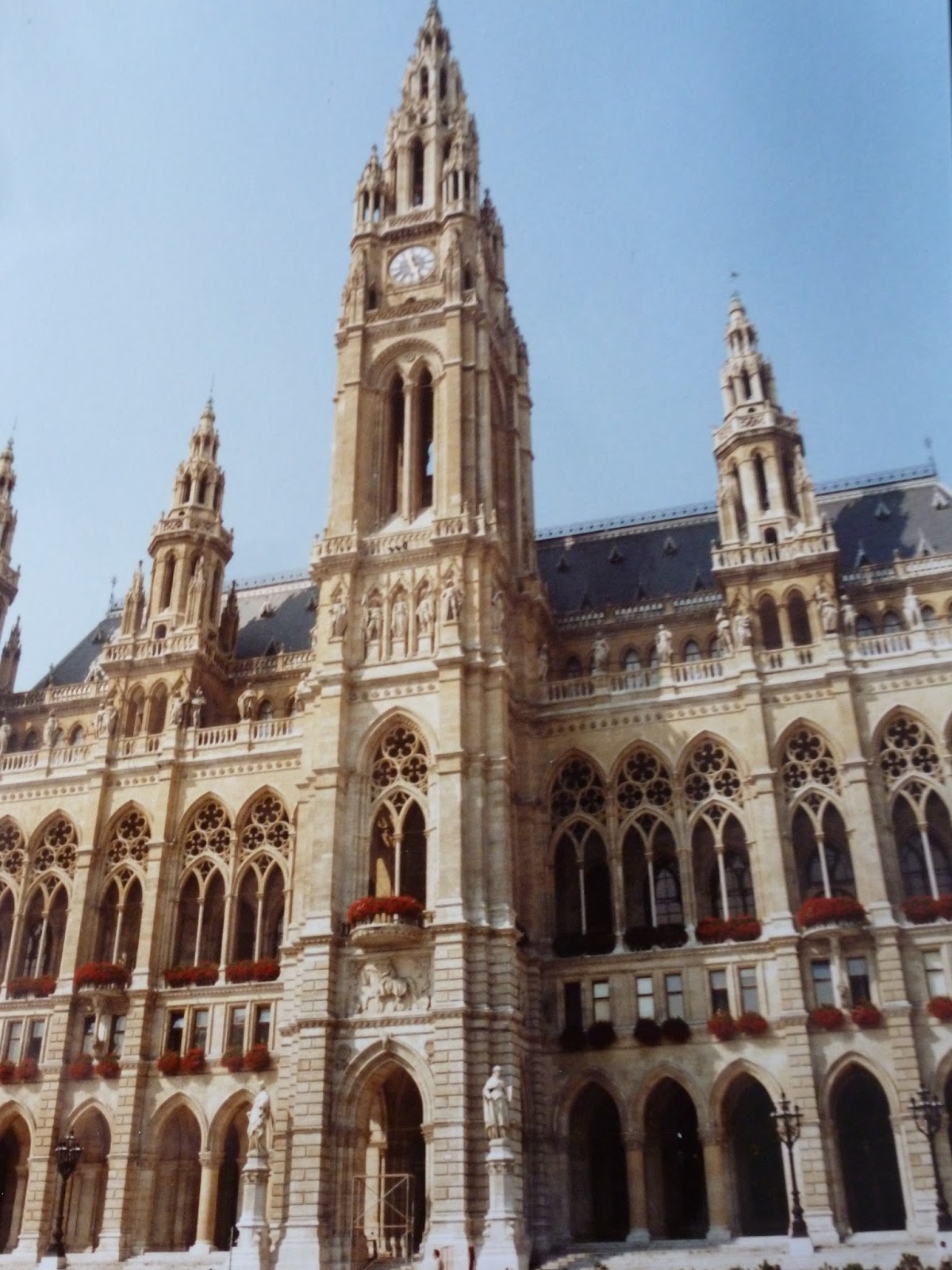
The Ringstrasse, commissioned by Emperor Franz Josef after he ordered the razing of the slums, is looking magnificent on our screens. So very white and pristine. It's just one pompous edifice after another. Theatre, opera, museum, parliament, palace. But all conveniently connected by tram.


Rathaus


But what's this? Uh-oh, I hear a zither. Michael, please don't do the Third Man thing. Orson Welles did it so much better. Oh no, here it comes. Sipping coffee, those large lips curling upwards in a sneer. Glancing sideways through bad sunglasses, looking furtive. As if anyone in a pink shirt could ever look furtive. It's all an excuse for Portillo to go on the Big Wheel in the Prater. His car is set up to dine.

I once spent a week in Vienna, the house guest of a flautist who played in one of the city's orchestras. He lived round the corner from the Schoenbrunn Palace, whose garden at the time was bursting with spring flowers. The apartment block was full of musicians, and the sounds drifting up the stairwell as they all practised in their separate abodes was mesmering, yet as cacophonous as Schoenberg. The flautist slept on a chaise longue, bought us McDonald's to eat each evening and had his life ruled by his mother. He also got us free tickets for a box at the ballet on the Ringstrasse, where - as an interrailing student - I have never felt so underdressed in my life.

It was a busy week. A homage to Beethoven in the city cemetery. My first chance to brush against Klimt's Kiss, where his pencil drafts were still visible below that wonderful gold leaf. A wall of lace at the Museum of Applied Art. Wine at a Heurige. And a Melange coffee which kept me shaking for days.

Karlskirche


Vienna has a brand spanking new Hauptbahnhof, from where it's finally possible to go East, South, North and West from a single station and stressful U-Bahn transfers are no longer required. Look and learn, London. Portillo heads off to the Semmering Pass, dressed in purple and orange. After a spot of sledging and a visit to Graz, he carries on to Ljubljana, the capital of Slovenia, which I still find impossible to spell without Googling. At the time of Bradshaw's it still had a German name - Laibach.

Llubljana

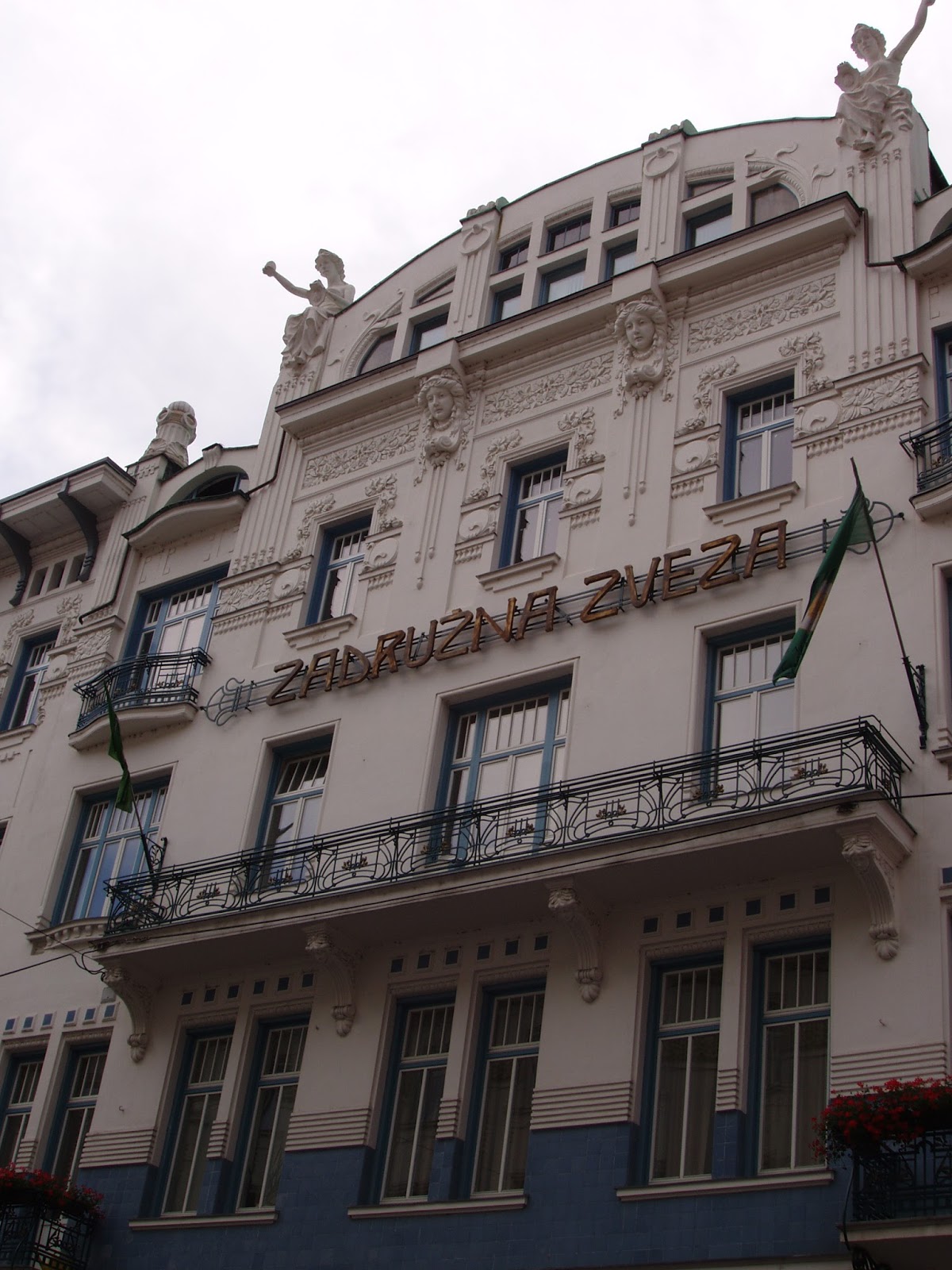
Ljubljana is beautiful. It has a vast array of colourful Secession facades, since half its buildings were lost in an earthquake on Easter Sunday in 1895, giving Viennese architects ample opportunity to show off their talent. It's a city where I ate mushroom soup out of a bread bun and cauliflower on a pizza. One was good, the other not so much. Portillo spends his time sharing fruit liqueurs with the ladies. Behind him is the V-shaped bridge and the pharmacy where I had to buy ear plugs as our hotel was so noisy at night.


Secession facades


A building painted in the colours of the Slovenian flag

We spent a week in Slovenia and I would rate it as one of my favourite countries to visit, ever. Such diversity within a tiny geographical area - Alps, meadows, waterfalls, castles, karst, coast. Venetian ports, Viennese cities. Warm, clean, friendly. My grumpy husband on a grumpier horse. A boat captain who brewed brandy-strength wine, sailed us to Trieste and gave me the worst hangover of my life. That should never be repeated, but a return visit to the country - one I day, I hope.

Alps, meadows...

Waterfalls...

Castles
Karst...

Coast

Saturday, 29 November 2014

Great Continental Railway Journeys: La Coruna to Lisbon

Look, I know, this is getting out of hand. But he keeps going to places I have been.

I'll spare you the Portillo stuff this time. I won't even mention this week's jacket or what he did to a custard tart. Instead, I will magically remove some sickening letters from his name and end up in Porto, which was visited halfway through this programme. My cousin lives there with his lovely Polish wife and many cats, and we went to visit them for a long weekend - gosh, nearly ten years ago now. It was an easy break - still living in London then, we could make the most of direct flights with Ryanair from Stansted.

We saw the railway station and the churches with their fantastic arrays of blue and white tiles. We ambled down the steep and winding cobbled streets of red-rooved houses with sheets of washing flung over the balconies, sidestepping several consignments of dog faeces in an otherwise never ending parade of lovely views. We ended up at the Douro river with its splendid bridges (the Ponte Luis I alas covered in scaffolding at that time) and barges stacked with port barrels. We sat in the bars and restaurants on the quayside eating rustic meals of salt cod and sow ear stews. And drinking port. Oh, yes, lots of port. Port on the water, port with a view, port on a boat, port in a port lodge or five, port at home. White, ruby, tawny, vintage, ancient. You name it, we tried it. We had excellent hosts.

Parts of our visit are consequently a bit of a blur.


A few bottles for the weekend


Friday, 7 November 2014

Great Continental Railway Journeys: Tula to St Petersburg

I shouldn't really be giving Michael Portillo any more wordspace. I've written about this programme before. But he has a new series. New routes, same idea. Same old battered copy of Bradshaw's. Same terrible jackets. In fact they've got worse. I can't actually think of a word for the shade of yellow Portillo was sporting last night. I have to come up with several. Creamy fluorescent not-quite-ripe lemon with a hint of Easter chick? He still likes to play the buffoon, though not necessarily intentionally. And he still likes to take his clothes off, this time behind a strategically placed pillar, ready to be scrubbed violently by men in funny hats.
Last night he was travelling in Russia. How changed it was from the country I visited on a school trip aged 15. Last night's Russia was colourful and gilded and vibrant, hi-tech and high-speed. Whereas when I went, in 1989, with glasnost and perestroika still new to the dictionary, Leningrad still called Leningrad, and the iron curtain still to fall, everything seemed brown and bare (although Leningrad did have a lot of yellow buildings with white pillars). Portillo was there in the long warm evenings of summer (he could thankfully even take those jackets off at times) and we were there in March with snow still on the ground, but regardless of the weather, it's a very different world there today.

A yellow building with white pillars
St Isaac's Cathedral

Moscow University
But some things would never have been the same, whatever the era, since we were there on an educational visit that was very much on the cheap. Portillo stayed in what were always luxurious hotels with famous historical guest lists, whereas we were forced out to the suburbs, into high-rises with broken lifts, 1970s decor, frightening electrical wiring, orange frosted glass, cleaners stealing our tights and KGB officers sitting in the corridor outside. The food was terrible, and we sat and watched the hotel cooks recycling our leftovers onto someone else's plates, and tipping ash from their cigarettes into our ice cream. Whereas even on a train, Portillo experiences fine dining. "Ochin harasho", he comments at every mouthful, with his supercilious grin. Portillo gets to down vodka; we were offered turquoise blue lemonade which may or may not have done irreparable damage to my nervous system. The lemonade was all we could drink - we were banned from touching the water in Leningrad. We weren't even allowed to brush our teeth in it. (The same water notoriously killed Tchaikovsky, after all.) And the mineral water we were offered came from the local marshes, with a lot of the marsh bottled with it.

Our hotel in Moscow, and how far we had travelled from it
before our bus broke down
Portillo's train from Moscow to St Petersburg took him only four hours, looked like a sleek and streamlined TGV or German ICE, and had reclining seats. We had to go overnight from Leningrad to Moscow in a metal prison on wheels, four to a cabin, with a drunk man outside trying to break into our berths (or "berthas" as our guide called them). Forty hysterical 15-year-old girls. You can imagine the squealing. We didn't see Portillo's railway Portaloo, but our toilet looked like this:


But anyway, we got what we deserved. The good things were all wasted on us. We ignored our teachers' instructions and disrespected authority. One of our group got arrested for taking a camera into Lenin's mausoleum even though we had been given strict instructions to leave all photographic equipment on the bus. We got sent to bed early for singing Bros songs on the way back from a beautiful choral concert in a cathedral. We only really enjoyed posing in our trilby hats on Red Square, telling everyone how evil Margaret Thatcher was, and buying Communist posters in the bookshop on Nevsky Prospect to pin on the walls of our classroom at school. I shall never forgive myself for being in the Hermitage (probably the greatest art gallery in the world) and feeling bored in the Impressionists room, just wanting to escape outside to hang out with my friends and go leer at sailors. And I brought home a tin of caviar, but fed it to my cat.

But even though we were so obnoxious, the Russians were not keen to let us leave, keeping us on our last day at Sheremetyevo Airport for hours and hours after our scheduled departure time, telling us that our plane hadn't turned up and our plane that we hadn't turned up. There being no seats, we had to sit on the terminal floor. Eventually, we were allowed to board, the air stewards just seconds away from their maximum permitted shift length, and the chicken Kiev they grumpily threw at us once airborne was the most welcome meal of my life.
Posing with a trilby in Red Square

The Hermitage, scene of the Russian Revolution and one of my greater moments of ignorance

Nevsky Prospect, Leningrad