Friday, 23 May 2014

Episodes

"And the Sunday sun shines down on San Francisco Bay
And you realise you can't make it anyway
You have to wash the car, take the kiddies to the park
Don't marry her, (have) me..." (The Beautiful South)
Got back from holiday to discover that a new series of Episodes had started. And since technically I can’t tell you anything about our holiday until I happen to watch a programme about Holland, I shall write about Episodes instead. Now into season three, it appears that much of the original premise (the transatlantic transition of an award-winning British sitcom in the hands of a cultural-nuance-oblivious, ratings-obsessed American television network) has been lost. We are now focusing almost exclusively on the love triangles (getting complicated enough to be verging on love tetrahedra) which have developed. To be honest, the details of these would have escaped me entirely had there not been a flashback at the start of the first episode. Though if in doubt, just assume Matt Le Blanc is shagging them. It would be nice to say that Matt Le Blanc is being terribly decent showing himself up like this, but really he is still playing Joey from Friends, just with a slightly higher IQ. Only this time when he is playing Joey in LA, the television programme featuring it has at least been successful.

The American guys (apart from one token camp one) are all big and beefy, and the American girls all skinny and plastic with ice-white teeth, as you might expect. The British have inferior dentistry and are as terribly polite and neurotic, equally as you might expect. Stephen Mangan plays his character like a lost puppy, and Tamsin Greig hers as a slightly wistful uptight eccentric. But by this point in time the British characters appear to be assimilating nicely to their film studio lifestyle. They power-walk in the Hollywood Hills but drive to work. They enjoy the glamorous parties and the luxury condominiums. Mostly the scenes are bathed in a golden glow, which may represent either the glorious Californian sunshine or the less glorious Los Angeles smog. Although the first scene of this series was set in a torrential downpour, which may just be because they film a lot of the show in Britain.

I have never been to Los Angeles. My picture of life there is enough to put me off visiting, even though this picture has been formed entirely from what I have seen on the television, both fictitious (on shows like Entourage) and factual (on, like, the news). LA strikes me as a place of ludicrous excess intermingled with the effects of extreme social deprivation. So you have the bullshit of pilot season on one side of Sunset Boulevard, and the genuine risk of a drive-by shooting on the other. You see corrupt police, riots and choking pollution, but somewhere nearby is Disneyland.

I have had to work with people in Los Angeles, however. Or rather in Burbank, since most of the film studios have long since left Hollywood behind. When I was working as a translation project manager for a DVD subtitling company in London, the company that owned us and consequently a lot of our clients were based in California. Generally this served as a source of irritation, since - thanks to the time difference - our American friends would arrive at work just as I was planning to leave. They would be full of (fresh coffee) beans just as I was fading at the end of my London day. They would usually hit upon some major problem that they could see many hours left in their day to solve. But the only hours left in my day were overtime, and unpaid overtime at that.

Eventually, to help us beleaguered souls in London, it was decided that one of our team should be moved over to Burbank on a rotational basis, each person staying for around a year. I was never among the ones selected, and never applied to be. But the ones who did go did seem to enjoy it, and some never actually came home. So life in LA must be a little seductive after all.


I have been to California at least, but it is a scarily long time ago now. The trip, undertaken when I was 19, is rather a blur, since when I was there I was taking some evil antibiotics for a case of giardia that I had managed to pick up in Glacier National Park, Montana. I also discovered in California that I don’t do heat all that well. Being British, I had previously thought that I quite liked hot weather, but this was the first time I’d experienced 103 degree Fahrenheit in the shade on the edge of a desert, and my coping strategies for this were tantamount to useless. Goodness knows what the family I was staying with made of me, but there must be a reason that the British people in Episodes are all portrayed as so neurotic. Anyway, I have vague memories of being driven through vineyards and a forest of redwood trees, and across the Golden Gate Bridge. I remember a strange house in San José (which I would dismiss as a heat hallucination now had I not just double-checked its existence) and walking along the boardwalk of an earthquake-destroyed Santa Cruz at night. I slept in a tent trailer in someone’s sweltering back yard and ate a lot of slightly dysfunctional vegetarian food. (And I just learned, as a sad postscript, that the father of the family I was visiting died a few years ago.)


My favourite place of all was San Francisco, because it was cool. Not cool as groovy, but cool as in cold. There was always a sea fret in the bay, which lowered the temperatures to an acceptable warm British summer level and meant I could function again. But even then, San Francisco is still vague in my head – Chinatown trinket shops, pyramid skyscrapers, sea lions, cable cars, curvy roads, Alcatraz, a tube train called Bart. But I see it every day on a painting that hangs above our TV in the lounge. It features the view from the top of Hyde Street, minus the cable cars, and is by my friend Nadine. The colours have the same golden glow that filters through Episodes.
Read the artist's blog here
(And the real Hyde Street)

Thursday, 8 May 2014

Vertigo Roadtrip

And just as I happened to mention my "crippling vertigo", there was a whole programme on about it. Not my crippling vertigo, needless to say, but people like me, who suffer from extreme acrophobia. Now, I had never previously considered my vertigo to be a phobia or indeed to be that extreme, but it seems that I am well up there with the people appearing on this programme. I hadn’t realised that it was that abnormal or unusual to have a racing pulse, jelly legs and a dizzy spell when crossing a narrow footbridge hundreds of metres above a river gorge. Or to imagine yourself falling off a skyscraper balcony. Or to crap yourself at the mere sight of a ten-metre diving board. Or to say “Ooh, I think I’ll keep my eyes shut” when in a cable car lurching up into the Alps.

Or maybe these people’s cases of vertigo weren’t as extreme as they had originally led the production company recruiters to believe, although a couple of them did throw a bit of a wobbly for the cameras after climbing just two blocks of stairs in a London office block. I reckon some of them might have just been after a free holiday. Because their cure through intense exposure therapy involved travelling to Innsbruck and Dubai. Really, if they were that terrified of heights, wouldn’t Blackpool Tower or a trip up the Shard have sufficed in the “scare them shitless” stakes? Not to say that the world’s tallest building, the Burj Kalifa skyscraper in Dubai, wasn’t worth seeing. It was astounding. And yes, if you can get yourself out in the open air at the top of that, you have definitely cured your acrophobia.

Mel Giedroyc (now suddenly brunette and without cake) was on hand to give everyone a cuddle as required, but the doctor in charge was an American called Jennifer Wild, an Oxford based psychologist and specialist in behaviour therapy. She was soft-spoken, with an intense stare, and knew how to apply gentle encouragement very insistently and effectively. Her clients responded surprisingly quickly to treatment (I would say suspiciously if I were considering the free holiday hypothesis). A grown man went from absolute hysterics in a swimming pool to leaping off a springboard into it quite happily in a matter of minutes. A woman wailed at the mere sight of a bridge, but was strolling across it in a great state of excitement just moments later. But all Dr Wild seemed to do to cure people was make them jump up and down or push against glass walls. I need this lady’s number.


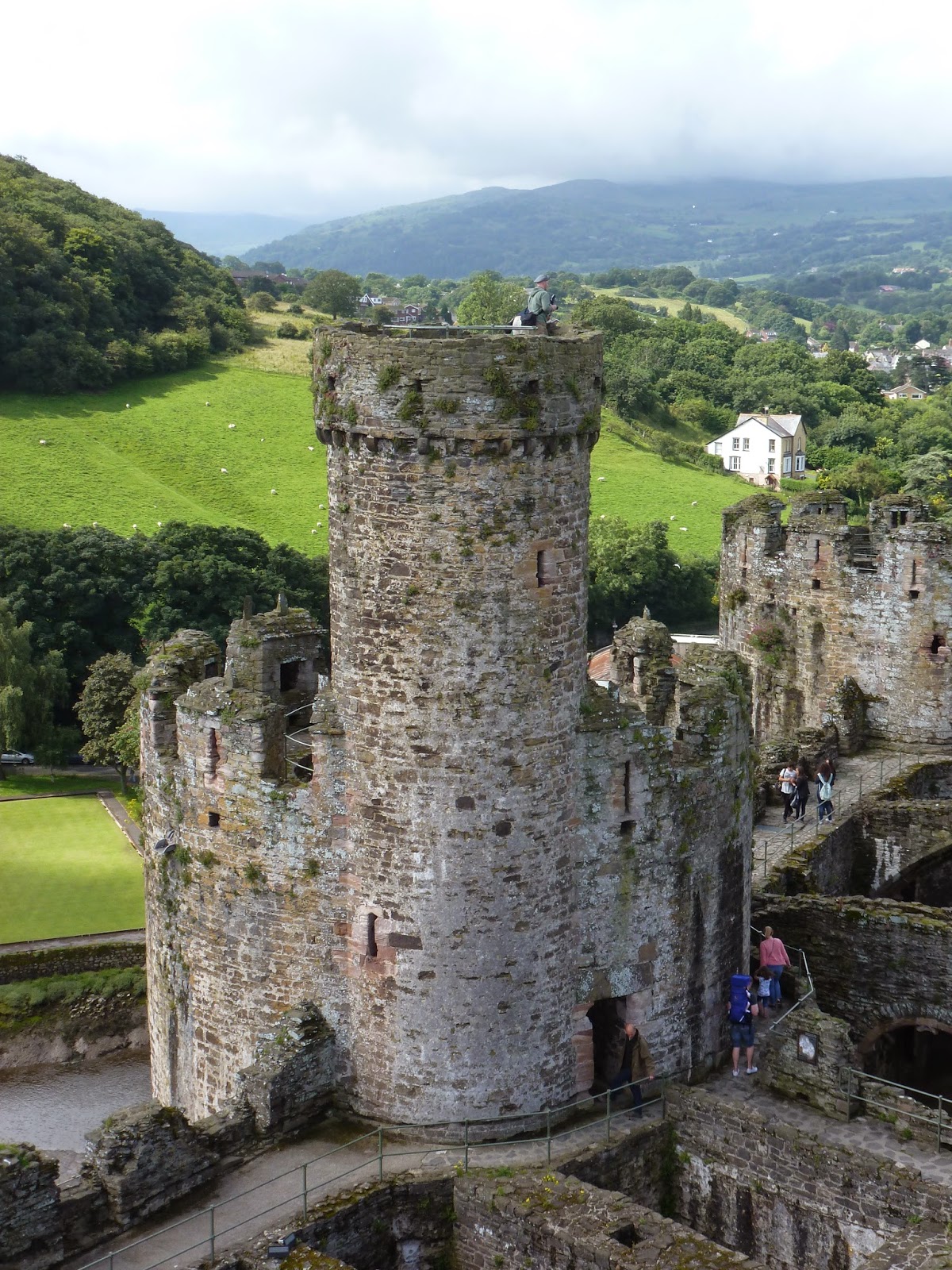
Because I have humiliated myself time and time again in various locations around the world. I have never completely lost it, but I have had what might be termed a “funny turn” atop various buildings, from the Sagrada Familia in Barcelona to Conwy Castle in Wales to the Sky Tower in Auckland to the Royal Albert Hall in London. I’ve had to sit down with my head between my knees until my breathing and heart rate have slowed. But I have always continued on my path, albeit looking straight ahead and my pace quickening, on various hideous bridges, like the iron one that goes to the spa in Scarborough, or the glass-bottomed one over the largest underground canyon in the world in the Skocjan caves in Slovenia. But blind panic and feeling close to fainting have never been far away. And please don’t mention Red Pike. Or the rope bridge in Alnwick Garden.

But I have an incident to compare myself to, which I use to convince myself that I am not that bad after all, and do have things under control. This incident occurred when my husband and I were on a group holiday to Jordan. One day we were taken by our guide on a hike in the hills above Petra, up to the High Place Of Sacrifice, via a less trodden back route. I couldn’t get myself too near the edge of any of the rocky viewpoints, but we saw a whole range of unforgettable sights, one of which was standing on the rocks directly above the Treasury, watching a constant stream of tourists snaking out of the Siq far below. My photos cannot do the constantly changing hues of pink, yellow, brown and red in the rocks justice, or the deep azure blue of the sky. 


Note there is always foreground in my cautious photography

However, on the way down to the Qasr-al-Bint in the heart of Petra, and nearly at the end of our trek, one of our group came a cropper to his vertigo. Before our final descent, we had to round a corner via a reasonably wide, flat ledge. The ledge had a ceiling of rock above it, but it offered no protection against a potential tumble down a steep slope of loose rocks and pink oleander trees to the ancient dwellings below. So this guy just freaked out completely. He refused to go any further. None of us, not even his wife (quite used to him doing things like this) could persuade him to put another foot forwards. In the end, he announced he was going to do the whole walk we had just done in reverse, which was a winding path of several miles over rough terrain that none of us could have committed to memory. Our guide, torn about what to do, chose to stay with the bulk of us but gave the man’s rationally thinking wife and an experienced walker from our party clear directions for an alternative shorter route down to the theatre in Petra. And he told them to meet us in the cafe at the bottom. Only they never turned up. They just decided to go straight back to our hotel in Wadi Musa. But we didn’t know this. Our guide panicked and spent several hours up in the hills near the High Place of Sacrifice trying to find them. Eventually the rest of us got back to the hotel, and found them sitting outside, enjoying a beer. We could then at least ring the guide (once he hit a patch of mobile signal) and let him know everyone was safe.

Vertigo man was only really on the trip in the first place because his wife had made him come. She was the one who wanted to see Jordan. His idea of a holiday was to sit around a pool drinking. And drinking is never the best thing to come and do in a Muslim country. But at least this incident made me feel better about my own vertigo.

But then, on the same holiday, I saw people do this...


and this...

And I realised that I really am not that on top of things, so to speak, after all. And as I remarked when writing about via ferrata the other day – what am I avoiding because of my fear? What am I missing?

Tuesday, 6 May 2014

Bear’s Wild Weekend With Stephen Fry

I had spent a few days wondering what to write about next when this popped out at me from the television schedule. It was billed as a programme about what happens when an active sort meets a cerebral sort on a testing trip to the wilderness. Stephen Fry, like me, is about the polar opposite of an adrenaline junkie, if polar is not too tactless a word to use given Fry’s much documented mental ill health. He is not especially physically active, is in fact rather unfit and carries a decent sized belly on him. He never stops exercising his mind, however, and remains forever funny, enviously eloquent, stupendously clever and fiendishly full of trivia. Any programme carrying his name will always attract me.

I have encountered far less of Bear Grylls however, being generally disinclined to put myself in death-defying situations and not needing to watch people who do. But I was a Girl Guide for a while, albeit a not especially enthusiastic one, and Bear is now apparently Chief Scout. Though on our guide camps we didn’t have our survival skills especially tested. And we certainly weren’t allowed to carry tampons or condoms around with us like Bear does. I don’t suppose any of us, aged 11, even knew what these items were in the naive early ‘80s. Bear uses a tampon (with a spark from his knife) to start a campfire, whereas our method was to sing Ging Gang Goolie with gusto. For Bear, a condom is a compact instant water carrier, whereas I think our campsites came equipped with taps. For Bear, tying a knot is something your life depends on. For us, tying knots was just getting cross with bits of string. The extent of our guiding initiative on camp was making a wasp trap out of a mallet and an empty tin of shandy. (We had a 13-year-old rebel in our midst.)

Bear and Stephen attempt to bond over the things they have in common. They were both sent off to boarding school at any early age. They both had daft nicknames at school, only one of which appears to have stuck. They were both subsequently expelled from these schools. Stephen ended up in prison, Bear in the army. This is about where the similarities end. But now they have been flung together for a weekend of adventures designed by Bear and aimed to test Stephen’s willpower and physical strength to the limit. Despite their differences, they both make an effort to get on, and to get on with the tasks at hand, tasks that are terrifying to them in their own way - Stephen's to do things like abseiling, and Bear's to have profound conversations in a suitably thought-provoking setting.

The setting is the Dolomites, that beautiful mountain range of jagged pinnacles in the far north of Italy that turn a pinkish hue as the sun sets. But as Stephen and Bear arrive, clutching the side of a helicopter, the cloud is thick and a ton of fresh snow has fallen. This means that the helicopter cannot land. So Bear and Stephen have to throw themselves off on to what the pilot has assessed to be a “soft spot” of snow, with the helicopter hovering precariously a few feet above the ground. You almost have the feeling that Bear has arranged the weather specially.

The snow has also buried the food supplies Bear has had delivered for the weekend by the Dolomites' equivalent of Tesco – a whole deer carcass. You can just see its legs jutting out of the white. “Is that a boomerang?” Stephen asks. They hack the carcass up and then produce the tampon to light a fire on which to barbecue a few choice morsels for lunch. Later in the evening, Bear serves up a venison stew, flavoured with Alpine flora (to match the faun-a). Stephen, picking the flora, says that he has been informed that no Alpine flowers are poisonous. The narrator tells us that Stephen has been misinformed. I am just wondering if Stephen has snuck a pile of Mars bars into his backpack, because these supplies seem barely sufficient to replenish the energy they have drained, when Bear produces a jar of Nutella from his. He smears this onto some bread, but just as you think this is all a bit too normal, it turns out it is bait to attract ants from a nearby nest as the topping for what Bear calls a mountain sandwich. He claims that the ants are full of protein, but the overwhelming flavour (despite the Nutella) appears to be that of formic acid, which no amount of pine needle tea (or Bear’s local grappa) can rinse away. “Tell Ant and Dec to get me out of here,” says Stephen. “Oh, except that Ant's gone.”

Bear makes Stephen climb down a vertiginous and partially frozen waterfall (Stephen screams that this is what yodelling was invented for), using via ferrata cables for support. Bitter battles between the Italian and Austro-Hungarian forces were fought in the Dolomites during the First World War, and the via ferrata were laid by them as a means of scrambling around the mountains. The soldiers also made a shelter, hewn into the rock, where Bear and Stephen spend the night. I seem to remember a character in the Sebastian Faulks novel Human Traces spending a lot of time in a similar cave in the Dolomites. As this character is a clinical psychologist, it seems fitting that Bear uses this setting as an opportunity to ask Stephen about his bipolar disorder. Stephen tells him that his recent suicide attempt made him finally lower his resistance to taking medication for his disease. He claims that as a public figure, after such a disastrous course of events, he felt the pressure to act responsibly. He also discusses his wish but inability to help everybody who writes to him about their own mental health problems, which is why he chose to serve as patron for Mind, the largest mental health charity of them all.

Stephen is exhausted but elated, and falls into a deep sleep. In the morning Bear claims Stephen's snoring is reminiscent of an avalanche. They must then extinguish their campfire, which Bear does by urinating on it. Bear says the fire must be thoroughly extinguished as it only takes "one small ember" to start a catastrophic forest inferno. Stephen, with his back turned to Bear weeing, remarks, "And it only takes one small member to put it out." Touché.

A similar moment of intellectual victory comes as Bear and Stephen discuss religious faith. They are sitting looking at what is indeed a heavenly view of a lush valley. For the Christian Bear, God made all this. The atheist Stephen asks but if He did, then who made God? Neither of these two polite fellows attempts to convert the other. Stephen is an apologist for atheists who criticise the beliefs of others, but then presents such a reasoned logic for why you should have no religion that if anybody from the church actually listened to him they would shut themselves down. Bear believes that we are surrounded by love – the love of God. This belief would make me unwilling to have Bear lead me through the wilderness, since he would have the fervent conviction that a supernatural force is guiding and caring for him. I would rather be taken by somebody who is willing and able to survive entirely off his own bat.

However, Stephen does survive his ordeal and copes remarkably better than I think I would in the midst of such gruelling challenges. Although Stephen does tempt me to consider being braver about giving things a go. But I can’t see myself ever attempting a trip on via ferrata, not even the tamer ones above Honister Pass in the Lake District, because of my crippling vertigo. This is before we even consider my build, which Stephen would also probably describe as a “bin liner full of yoghurt”. I do love a good mountain holiday though. But I prefer my ropes to be attached to a cable car rather than a rocky edifice. And I prefer my views to be easily accessible from a hotel balcony, rather than a cave. Like this view we had of the Jungfrau from the Hotel Edelweiss in Wengen one glorious week in July 2009. And if some news reports are to be believed, Bear may well think the same way.

Tuesday, 29 April 2014

The Trip To Italy

For some reason (most likely it being on past my bedtime) I missed the first series of The Trip. Steve Coogan and Rob Brydon drove around between various fancy restaurants in “the north” (mostly the Lake District), supposedly to review them for the Observer food magazine. Coogan and Brydon themselves subsequently got great reviews for their performances (though I only read the reviews in Cumbria Life, for which my husband’s grandfather buys us a subscription every Christmas), so I was keen to watch its follow-up. This time the same two actors and comedians (or comedians and actors) have been sent by an equally fake Observer food magazine on a gastronomic trip to Italy to write about six more restaurants.

It’s the sort of holiday that most of us would die to go on, but Steve Coogan only very grudgingly accepts his mission in the opening credits. And I can’t say either of them properly exude enthusiasm for the task at hand at any point. But off they go, in a black Mini Cooper whose leather seats make them sweat like the middle-aged men that they are. They are trying to follow in the footsteps of Romantic English poets Byron, Keats and Shelley, but are far from natural poets (or romantic) themselves. At least when it comes to the food. I can’t imagine what they are going to write in their reviews given that the only adjectives they come up with while eating it are “good”, “very good”, and “nice”. At least we get a quick flash of the food’s creation by its chefs in the kitchen and a brief glimpse of the finished product on their plates as the waiter or waitress serves them. But Brydon and Coogan hardly dwell on it. They almost ignore it. They spend more time looking at the bill. And they never, ever order pudding. Not even a little gelato. For heavens’ sake! Come on, guys, there’s at least one salivating lady in your audience, and it’s the sight of something sugary that she craves.

What she certainly doesn’t crave is the noise the two of them are making. Not undignified pasta slurping, lip-smacking sighs of satisfaction, or big fat belches, all of which would be perfectly forgivable given the circumstances. But the non-stop banter. It’s apparently all improvised, some of it is indeed quite funny when it’s not blatantly misogynistic (just how do you pronounce Jake Gyllenhaal’s surname?), and the impressions are, well, impressive. But after a while it all becomes very hard work to listen to. I don’t need Hugh Grant/ Michael Caine/ Roger Moore/ Frank Spencer or even Saddam Hussein doing Frank Spencer being thrust down my throat when there is all that fabulous food to be talking about. And if not the food then the incredible views they should be enjoying – sunlit beach coves, tumbling Tuscan hill towns, rainbow coloured Mediterranean ports, Roman marble. At one point they briefly acknowledge that “sea on pebbles” is one of the most beautiful sounds you can hear, before the tirade starts up again, with both of them cawing like crows.

I don’t mind the in-car banter, especially when accompanied to them bobbing up and down to Alanis Morisette, which makes them look faintly ridiculous. We can all relate to them getting lost in the middle of Rome traffic, or yelling at the sat nav. The car is generally a good place for shouting people down. But not a restaurant where in reality everybody else is sitting quietly, breathing, eating, drinking, relaxing. Ahhhhhhh...

Coogan and Brydon are allegedly being themselves, and yet they cannot be, since their personal backgrounds (partners, children etc) are made up, and things (such as infidelities) happen that you would like to think might not in real life. Some of their teasing has a basis in what we know as fact (too many panel show appearances, too much time in LA), but there’s not a lot that you can actually trust. Much of the repartee is presumably an “I’m a celebrity in public” defence mechanism, lest they should accidentally have a proper conversation and reveal too much of themselves. The pair need to show us their trade and do, constantly. As does Michael Winterbottom, a prolific film maker whose beautiful cinematography at least does the backdrop justice.

I have been to Italy many times, and would go many more if I could. I learned Italian at school and my basic knowledge still serves me well in most situations. It was a country we had been desperate to take our daughter for a long time, and – like Coogan and Brydon - precisely because of the food. Italy was the one country on the planet where we knew we could feed her without having to take a suitcase full of baked beans. Her average toddler fussy eating is generally restrictive, but as she will invariably eat pasta, pizza and ice cream, Italy had to be a sure-fire winner. But we didn’t think we could afford it. Plus to access so many of the more scenic parts of the country you need to hire a car, and driving in Italy is not that appealing when you lack Steve Coogan’s enthusiasm for cars.

But then a friend of mine told me she had booked a trip to Lake Garda with Eurocamp, and after some quick research into prices and what was on offer, a couple of days later we had done the same. I don’t think she minded too much that we had shamelessly copied her holiday. We found that for £250 in late September we could have a week’s accommodation in a mobile home on a campsite in walking distance of Peschiera del Garda. Even after booking flights to Verona, we still had paid out less than you do for a lot of holiday cottages in the UK summer season. We could have done the transfer from Verona to the campsite on public transport, but with a young child, a push chair and two suitcases in tow, the 100 Euro return taxi transfer was well worth it. And still a lot cheaper than hiring a car.

We had a wonderful and genuinely relaxing holiday, blessed with unusually hot and sunny weather for the time of year. The campsite pools should have already closed for the season, but had been kept open indefinitely. The lake itself was much warmer to swim in than the pools, however. It just came with swans. We had originally had grand visions of exploring the length of the lake and doing a day trip to Venice to mark our wedding anniversary. But when it came to it, all our daughter wanted to do was sit on the lake shore throwing pebbles into the water, and we were quite happy to sit and watch her. For a while at least. Peschiera del Garda is perfectly pleasant, but not the nicest place in the area, which meant we still wanted to explore a little further afield. So we downsized our planned excursions to places within half an hour’s travelling time, by boat, bus or train. These did not include Gardaland (may our daughter never learn about Gardaland...), but did include Desenzano, Lazise, Verona and Valeggio.

Throwing pebbles
The latter was as close as we got to a gourmet experience in Italy. No Michelin starred establishments for us. Generally around Lake Garda the food is very aimed at tourists, and German tourists at that. Most restaurants have photos of each dish on the menu, which I never take as a particularly promising sign. They are also quite expensive, so we usually opted for a basic pasta dish and never a main course, apart from on our aforementioned anniversary, when I had a dish of lake perch to celebrate. Wine was inevitably a half-litre carafe of house white or prosecco for five euros. And dessert was always a visit to a gelateria, where for some reason our daughter, when presented with an array of at least twenty different flavours, always opted for strawberry. A bit like if she was in Bod.
  
But Valeggio is a town famous for its tortellini production and has dozens of pasta shops lining its streets and piazzas. On the recommendation of a friend, we walked down the hill to neighbouring Borghetto, a village of medieval watermills and restaurants built on a weir across the Mincio river. The lunch we had here was superb, its upmarket nature evident from the wine only being available by the glass or bottle rather than the carafe. The tortellini – meat for my husband, pumpkin for me, just melted in your mouth. 

Our lunchtime restaurant in Borghetto


View from the Giardino Sigurto towards Borghetto
After a stroll around the magnificent Giardino Sigurta back up the hill in Valeggio, we bought some more tortellini to cook in the caravan for tea. But I made the mistake of not noticing anchovy (acciuga) next to aubergine (melanzana) on the list of ingredients. There are only two things in this world that I don't eat - Brussel sprouts and anchovies. Anchovies are Nasty with a capital N. Thankfully we had bought some more pumpkin tortellini as well.

Tortellini di Valeggio

I wonder if I will be allowed to get away with cooking pasta in pesto sauce every night when we return with Eurocamp to Holland very soon? Somehow, if no longer in situ, I doubt it.

Sunday, 27 April 2014

Endeavour


In our house we resist most drama on ITV, but not anything belonging to the Inspector Morse franchise, it seems. Whilst Lewis got so dull that even its two main characters resigned on screen, I do really like Endeavour, the 1960s-set prequel to Morse. It’s gloomy and dark, with grey (not black or – ahem - noir) often the predominant on-screen colour. Gramophones crackle and typewriters clatter behind the refrains of Barrington Pheloung’s theme. Morse listens to opera and solves crossword puzzles in his dingy bedsit rather than his opulent future Victorian mansion, and he doesn’t own a car yet, but everyone else drives ones just like the one that he will. Motorway service stations are just a business idea that require explanation. Not that I can quite picture Morse in any guise sitting in a Welcome Break.

Endeavour is all slightly dumbed down for an ITV audience of course, and the classical music is so mainstream even I have played or sung it  – a Chopin Nocturne, Mozart and Brahms’ German Requiem. The Oxford colleges still have their stupid fictitious names - Pelham (an electricity substation in Hertfordshire), Lonsdale (a bad pub in West Jesmond). But there are a couple of clever nods to Morse fans. Author Colin Dexter continues to make cameos - spotted on a bench, a double decker bus and during the obligatory scene (there’s one in every Morse-related series) in the Pitt Rivers museum. Future Chief Superintendent Strange is a fellow Constable. But best of all, the local newspaper editor is called Dorothea Frazil. Frazil is a type of ice crystal, so using her initial, her name D(e)-Frazil means “Thaw”. As in John. And – ta-da! – this self-same newspaper editor is played by John Thaw’s daughter Abigail. I didn’t work any of that out myself, incidentally. A Guardian television reviewer, embarrassed because he had thought Abigail Thaw was actually playing the murderer in a previous episode, took great pains to point it out.

So Morse as a young cop is already an intellectual, and quiet and moody. At the end of series one, he acquires his character’s famous future limp when he is shot. But as I can’t remember the plot of episodes from one week to the next, don’t expect me to tell you by whom. But he was still very traumatised about it all at the start of this series. He is in the pub a lot more for one thing. He has fallen for his next-door neighbour, a nurse, but we know (having seen the future) that the romance must be doomed. And he ends this series in prison, but in Oxford that's OK, since the prison is part of the Malmaison hotel chain.

Morse’s boss, DI Fred Thursday, is played by the great Roger Allam, who I once saw play Willy Brandt in Michael Frayn’s Democracy at the National Theatre, and who I now regularly hear narrating Sarah And Duck on CBeebies. Fred Thursday seems like a boring pipe-smoking middle-aged man in the height of Oxford suburbia, with two teenage kids and a different sandwich filling for each day of the week. However, it transpires that something terrible happened to him during the war in Italy, and something even more terrible happened to him at the end of the series finale on Sunday, when it was his turn to get shot.

I would say that Endeavour, by being grey rather than noir, doesn’t have anything remotely like the nail-biting edge of BBC4’s Danish imports, although the final episode of this series gave it a good go. The ghost story episode in the girls’ boarding school was unconvincing because you knew it would have a boring Enid Blyton type explanation. And the department store (Burridge’s) that was the centre of the action in episode three seemed to have been modelled on Grace Brothers in Are You Being Served?, with its stockinged mannequin legs, wooden panelling, blonde bimbos, dirty brown caretaker overalls and lewd conversation between the staff. The characters wearing poppies rather than Captain Peacock’s red carnations in their button holes was the only discernible difference. But Endeavour deserves respect, and he genereally gets it from his public at large, whereas anyone that Lewis interviewed was invariably rude and brushed him off as quickly as possible.

I started going to Oxford in the early 1990s, when some of my school friends went off to university there and I went down (or should that be up?) to visit them. I myself had rejected Oxbridge (rather than Oxbridge rejecting me). Their languages degrees distinctly lacked the “modern” moniker and had syllabuses (syllabi?) devised sometime not long after Noah left the ark. I got the grades but know I couldn’t have handled the stuffy academic pressure, or the public school tossers who went there. But one friend was at St Hugh’s, one of the more down-to-earth colleges, located a little out of town in a beautiful rambling Edwardian garden not far from the Cherwell punts. And I always felt very at home staying there. I was even there on my 21st birthday, for which my friend not only very kindly vacated her room for me and my boyfriend to sleep in (she did have a boyfriend of her own to crash with), but also turned up on the doorstep first thing the next morning armed with a bottle of bubbly for our breakfast. Ah, these Oxford types know how to party.

The out-of-town more modern colleges never seem to feature on Morse, however, although the Cherwell boathouses sometimes do. The same few traditional colleges appear over and over again, presumably the ones with quadrangles permanently set up for film crews wishing to throw corpses off the roof. The Sheldonian Theatre and Bodlean library are also familiar backdrops.

Thanks to my lovely cousin for supplying these photos
But I am ashamed to admit that the places I recognise most in Endeavour, Lewis and Morse are the public houses. Fast-forwarding a few years to a time when I was salaried, single and living in London, I was introduced to most of the more famous Oxford beer taverns in the course of a single weekend, when I went to stay with an American friend of a friend who was doing an MPhil at one of the graduate colleges. Delighted to have a fellow real ale lover to entertain for a couple of days, she immediately marched me across the meadows upriver to the Trout at Wolvercote for lunch, and once we had staggered (it was a very big lunch) back into town, took me on to the Eagle and Child and the Turf before ending up at a true hidden gem, the Old Bookbinders by the canal in Jericho. Here the beer flowed straight from the barrel and they did a special tasting tray so you could try up to six different ales at a time.

A couple of years after this, I began to find myself in Oxford more regularly. In trying to get himself a job nearer to me in London, my boyfriend (a different and better one, now my husband) had ended up working for Swindon Borough Council. He had been in Carlisle before, so pretty much anywhere in the country would have been nearer to London. So it was a bit of a shame, really, that he ended up in Swindon. I will be careful what I say here, since I know that at least one of my friends is Swindon born and bred, but, well, as a 1960s new town it’s not the nicest place in the country. But it does have a good designer outlet shopping mall and a Magic Roundabout. My boyfriend was frantically writing up his PhD at the time, so it was probably good that Swindon didn’t offer too much in the way of distraction. Often when I was visiting, we would not spend very much time in Swindon at all, but instead head out for the day to Bath, Avebury, the Cotswolds or Oxford.

And when the PhD writing reached its peak and my boyfriend could no longer spare full weekends for me, we would meet just for the day in Oxford, with me hopping on the coach from London Victoria. It worked out very well. There was a lot of drinking – often in the aforementioned ale houses, and often before lunch. Sometimes we would buy a picnic of bread and cheese from the indoor covered market and take it to the river, University Parks or botanical gardens to be washed down with a bottle of wine. One evening we did stay over, and ended our dinner with a nightcap of a chocolate cocktail which was so delicious I can still taste it today. We went for long walks and watched a lot of matinees at the Phoenix Cinema. Happy, naughty days. And no one, as far as I am aware, got murdered.

Wednesday, 23 April 2014

The Battle For Britain's Breakfast

I watched this on a bit of a whim, but it turned out to be surprisingly interesting. It’s hard to believe that there was once no such thing as breakfast television. Once upon a time, the only TV before lunchtime was Open University lectures or that test card of a girl playing noughts and crosses with a scary clown. She was a big part of my youth, that girl. My mum couldn’t shove us in front of CBeebies all day long, but she could let us loose on the test card. I am sure that clown had a lot to do with a childhood phobia of the circus.

This documentary detailed the ratings war between ITV and the BBC after the government gave permission for channels to start broadcasting in the early morning. The ITV franchise was awarded to TV-am, and the cheeky BBC decided to launch a rival show two weeks before it went on the air. The first Breakfast Time on BBC1 in 1983 was a big event in our house. (We plainly had no life.) We were always very much a BBC rather than an ITV family, though me and my brother were allowed to watch Rainbow at lunchtime so that my mum could then tune into The Sullivans. So Frank “combover” Bough and Selina “Clothes Show” Scott were regulars in our house, and we only saw Good Morning Britain when we went to visit my nanna in the Lake District. So I was quite surprised to learn that people that I had remembered being on ITV, like Russell Grant and the Green Goddess, were actually on BBC Breakfast Time. Or I guess these were assumptions rather than memories. But that is what the whole ratings war was about – the BBC's breakfast show, with its jumpers and sofas, was trying to be like ITV, whereas the TV-am broadcasts, with David Frost, Parky, Angela Rippon, Anna Ford and a serious news content, were trying to be like the BBC. It didn’t work out for anybody, although the BBC was winning the ratings war. Behind the scenes at TV-am there was a lot of treachery. Famous people got sacked. Jonathan Aitken was a baddie even then (he got wine thrown over him by Anna Ford - you go, girl!). TV-am went virtually bankrupt and could barely pay for enough electricity to keep broadcasting. Greg Dyke, now chancellor of my alma mater, The University of York, brought in a rat puppet called Roland to save the day. 

Eventually things came full circle. The BBC relaunched Breakfast with people in suits behind desks (to make people want to go out to work), and ITV became increasingly tabloid-influenced and sofa-based (to encourage stay-at-home couch potatoes). And since then everything has more or less remained as you might expect.

My grandfather was once on Breakfast Time, when he became the first person to climb all the mountains in England, Scotland and Wales over 2,000 feet high. However, he was filmed on location, asleep in the back of his Volvo, and hiking up his final hill, rather than being allowed on a sofa. Those who knew him would probably agree that my grandfather didn’t look comfortable on a sofa.

It’s sadly ironic that The Battle For Britain’s Breakfast was broadcast the day after the death of Peaches Geldof. Her parents were, of course, very involved with Channel 4’s own early morning programme, The Big Breakfast, which (since it didn't air until nearly a decade later) played no part in this documentary. I once walked past the house where The Big Breakfast was filmed. It was next to a grotty canal towpath that was on the Capital Ring, a 78 mile walk around the edge of London which my husband and I completed one summer. The walk is split into several easy sections, the beginning and end of which are all accessible by public transport, usually from stations in zone 4. I wrote of the Capital Ring in 2006:

“Like all of London, the Capital Ring embraces contrasts. You see some of the most opulent (Richmond) and some of the most squalid (Hackney Wick) parts of the city suburbs. There are palaces (Syon House, Eltham) and sewers (the Greenway). There are streams, canals and rivers, forests, woods, parks and open meadows. There is the world’s ugliest hospital (Ealing). There is a windmill (Wimbledon). There are cranes, swans, ducks, coots, squirrels, rats, voles, mice, woodpeckers, jays and rutting deer. There is dog shit (Crouch End’s Parkland Walk). Some areas are undergoing rapid change and construction, such as the Docklands and 2012 Olympic Park to be. Some are undergoing painfully slow change and construction (Wembley stadium and, if I think about it, the 2012 Olympic Park to be).”

Anyway, if you live in London, I wholeheartedly recommend that you give the Capital Ring a go. We loved it and were very proud of ourselves when we got all the way round. We embarked on the walk's bigger brother, the London Loop, but sadly didn't get to complete this before we had to move away.

I was surprised to read that the Big Breakfast house is still standing now, since it was right in the area where the Olympic Park was going to be built. Apparently it fell under a compulsory purchase order but didn’t in the end need to be demolished.

The first subtitling company I worked for had two contracts to subtitle the news segments on breakfast television, one for Channel 4's Big Breakfast, and one for GMTV, TV-am's successor. Being fresh out of university, I hadn’t had any experience of serious early rising, so never volunteered to cover these shifts myself. Now, with a young child and never getting to sleep beyond six in the morning, I’d be signing up for them like a shot, as you got a taxi ride into work (the Tube not being properly up and running at that time of day), paid extra, and could slope off home after lunch. (Though to be honest, given the cuts to subtitling budgets over the years, I doubt these terms and conditions would still apply.) Subtitling for GMTV was done at their studios on the South Bank and there was also a rumour that if you popped out to make yourself a coffee at the right time, you could also get yourself on television, as some interviews were filmed outside the subtitle transmission room. Our involvement in these breakfast shows' production was hardly as cut-throat as the world portrayed in the Battle For Britain's Breakfast, but the subsequent loss of the GMTV contract was definitely the start of our own company's demise.

Tuesday, 22 April 2014

Masterchef

And suddenly it was the Easter holidays, most of which my daughter spent coughing and not sleeping, meaning I’ve been feeling ghastly too and the blog has had to be temporarily shelved. I suspect this will happen a lot. Nonetheless I persevere. There is, I promise you, more writing in the pipeline.

But in any case, recently I have been mostly watching Masterchef, so there is currently little variety to my television viewing. This series seems slightly condensed and speeded up in comparison to earlier ones, since it’s “only” on three nights a week. There’s the familiar velvety voiceover saying the obvious about what’s on the plate, contestants saying “I’m here to go all the way” or “I hope I’ve done enough” or “I’m absolutely gutted - I still haven't shown them my best” (why the hell not?), former champions brought in as critics saying, “Oh no, they're going to deconstruct something", John Torode saying, “This is a lovely, lovely thing” and Gregg Wallace strutting around saying little more meaningful than “Phwoargh!” Interspersed there is cooking ranging from the ridiculous to the sublime, with smears. As usual, it’s all in the seasoning. Everyone does everything in the final minute. No one, it seems, can cook rice. Figs and cranachan are all the rage. John Torode is cooking more on screen than he used to, trying out the sweet or savoury invention test or demonstrating one of his own dishes that the contestants then have to replicate. His Asian-influenced fusion food is a lot more delicate than his manner.

To get myself back up to blogging speed, the travel section of this entry is simply going to be a link to my Italian cookery lesson with Sara Danesin Medio, a former Masterchef finalist who now runs a dining club in York and who (I have reliably been informed) will feature on this Wednesday’s episode. As some of you will recall, to do a cookery course was one of 40 challenges I set myself in the year running up to turning 40. It was a wonderful day. Ironically, the coughing daughter was ill then too...