Friday, 22 January 2016

Deutschland '83

"In touch with the ground
I'm on the hunt, I'm after you
Smell like I sound, I'm lost in a crowd
And I'm hungry like the wolf ..."
    (Duran Duran)


A rollicking ride with subtitles. Has to be a good thing, right? Sunday night television has turned into a battle of the drama Titans - War And Peace versus Endeavour versus Deutschland '83. Deutschland '83 is a German spy thriller from Walter Presents, Channel 4's new foreign-telly box-set-on-demand service. I'm sticking with Endeavour, then treating myself to Deutschland '83 during rare solitary moments of leisure. I'm using our new Chromecast, so that I can watch our tablet on the big(gish) screen of our television. It's been quite the revelation, even if our daughter now spends most of the time watching clips of cats being scared by cucumbers on You Tube rather than CBeebies. Gosh, we are almost in the digital age in our house at last.

Which is more than we can say for the East Germans. Seeing them fail to keep up with Western technology is one of the greater sources of amusement in Deutschland '83. They are stumped when a break-in to a safe gives them a list of nuclear targets stored on an encrypted floppy disk. It's not the encryption that's the problem, it's the actual disk. Their computers can't play it. They need an IBM, illegally procured and imported. And then there is the hero's dumbfounded attempt to master the phone switchboard in his office. And his naive response to a black marketeer offering to sell him a Walkman: "What's a Walkman?". The look of sheer astonishment and adulation on his face when he hears Duran Duran playing through headphones for the first time is glorious.

The music is wonderful, of course, if you are of a certain age that is mine. Yes, even 99 Luftballons. The theme song is Major Tom, but sung by Peter Schilling, not David Bowie. Though the name still feels poignant in the week of Bowie's death. Bowie's music features elsewhere - China Girl, Modern Love - alongside New Order, The Eurythmics, The Cure, The Police, Blondie and 10cc. And we're only on episode three. Further delights await. But there will be Phil Collins at some point. Even in the early '90s, German radio was almost continuous Phil Collins.

"Earth below us, drifting, falling, floating weightless, coming home..."
Our hero is Martin Rauch, former East Berlin border guard and now, thanks to an agent aunt who indulges in nepotism, Moritz Stamm, East Germany's newest spy recruit. But - oh dear - turns out he's pretty rubbish at it. Every week he messes up, but somehow gets away with it. It probably helps that he is posted to a West German general who is so distracted by the antics of his own children (one a soul singer on a Bhagwan commune in Cologne, the other a newly recruited pacifist) that he totally fails to notice suspicious goings on around him. Like his sister-in-law getting drugged at a party after she stumbles across Moritz making an illicit phonecall. Like Moritz clumsily dropping crucial bits of paper during information exchanges. Like Moritz splattered in blood after nearly being killed by a Ninja waitress. Like Moritz failing to recognise an old friend from his hometown in Braunschweig and the old friend failing to recognise Moritz - because the real Moritz Stamm has been shot dead on a train. Like Moritz sneaking off to his chain-smoking aunt's car at a petrol station to have blood taken to see if he can be his mother's kidney donor. (And what everyone in Germany - not just the General - failed to notice in that scene was that Moritz got back into their car and managed to drive off despite a) having left a petrol nozzle attached to it in the previous scene and b) not having paid.)

Lamps get bugged, offices get broken into. Sometimes it isn't Moritz's incompetence but twists of fate that intervene. American generals decide to switch hotel rooms because one fancies a view. A bugged Art Deco desk meant for a Nato official is gifted on to his secretary. An antiques dealer works late into the night, letting his friendly dog sniff around his shop while Moritz attempts to bug said desk. The girl Moritz has to seduce to procure secrets loves cats, but Moritz is allergic.

A desk switch in Brussels

Martin/Moritz is doing it all for love. For his girlfriend back home, who is pregnant, but not necessarily with Martin's child. For his mother, in desperate need of that kidney transplant. Getting her treated in a West German hospital is the bribe meant to lure him. That and the recruiter breaking Martin's fingers - the real Moritz Stamm was an accomplished pianist, and Martin can't play a note. So it fills a gap in the story and tortures Martin into submission in one fell swoop. Clever, but not nice. They drug his coffee to finish the job.

Despite occasional violence and everyone trying to prevent nuclear armageddon, the mood is light. Both sides seem equally clueless, which is not what you expect from German officialdom. It's a bit too Austin Powers at times. I don't think life under the Stasi at the height of the Cold War can have been that funny. Although East Germans always struck me as having a better sense of humour than West Germans. However, I am not looking forward to what pregnant Annett, a loyal teacher of Young Pioneers, might do with her discovery of Martin's mother's hidden Western book collection, many titles of which Martin procured for her during confiscations at the border. But we shall see. Having baby brain, she might just wander off and forget all about it.

There is clearly good money in being a double agent. Tischbier, the pacifist leader and Moritz's spy boss lives in some sort of palace. Moritz needs to brush up on the high life if he is a success - his lack of knowledge of steak ("Just bring me some meat from a cow") is what leads to the later Crouching Tiger Hidden Dragon assault by the waitress. Moritz's previous exposure to haute cuisine has been his aunt smuggling in Nescafe. He finds the choice in a Bonn supermarket overwhelming. It's infinitely more impressive than any German supermarket I've ever been to.

It's hard to believe that it all takes place only five years before my first ever trip to Germany. And only six years before the fall of the Wall. The system in 1983 seems utterly entrenched and impenetrable. There is genuine threat, and no sign of change. In 1988 I probably knew little about the East, and had only got as far as 1924 in my school history lessons on Germany.** But 1988 is the year I went to Cologne and Bonn, where Moritz is stationed. I was 15, and on a school exchange. It was a whirlwind day trip from Mainz, and while we devoted a reasonable amount of time to Germany's highest motorway bridge, Cologne cathedral and a lunch of chicken and chips at Cologne station, we only managed to see the main squares of both cities. Oh, and the outside of Beethoven's house. Bonn seemed far too small and - dare I say? - parochial to be a capital city. It is so right that the accolade was subsequently restored to Berlin. I wouldn't mind a piece of one of those now abandoned embassy buildings though - then I could live like Tischbier.

Genuine 1988 Cologne beer mat, which must have supported lemonade

Beethovenhaus, Bonn, dingy '80s photography


** Interestingly, my first German teacher, whom we all suspected of Communist tendencies because she wore black trousers, rode a motorbike and we were stupid teenagers, taught us that the word for "orange" was Apfelsine. Whereas two years earlier in 1983, Apfelsine is one of the East German words that Moritz is told he must forget, and use Orange instead. So now I'm wondering if we were right all along...

Thursday, 7 January 2016

Sherlock

One of the things I love about Sherlock (the others being the cast, the pace, the music, the wit and pretty much everything else about it) is the fact that it is set in the modern day. But this special New Year episode took place in Victorian times. Hm. "Well, that's not very original, is it?" I thought when I saw the trailer. Why mess with a good thing? Why go back? Because it's where Sherlock was created? Because Dr Who writers like time travel? Because there are always past crimes that need solving?

Although fear not, it did turn out to be a little bit original in the end. A lot of it took part in Sherlock's head - or "mind palace", as he called it - and not in Victorian times at all. Er, right. It seems that a lot of drugs were consumed in the making of this episode.

It was possibly all just an excuse to get Moriarty back. Because what it boiled down to - as it did, coincidentally in And Then There Were None - is how you can be seen to have your brains blown out by a shot to the head and yet go on to commit more murders. It's all about the art of the accomplice, the illusion, and the morgue getting the right body at the right time.

It was fun, fast and furious, and just a little bit bonkers.


And a lot of it was filmed at Tyntesfield, a National Trust property close to the M5 and Bristol, where we spent a rainy day in August. It didn't mention its Sherlock connections then, though. I think it had been sworn to secrecy. But as of now, it's got a whole Sherlock trail for visitors to enjoy. But sadly no Benedict Cumberbatch at the end of it. Although maybe the odd photo of him looking aloof in a deerstalker, if you're lucky.


Tyntesfield is apparently "a masterpiece of Gothic revival architecture", which no doubt appealed to the Sherlock creators. It was home to the Gibbs family, who were wealthy rather than aristocratic. That means to say, they weren't posh. It definitely has the air of a home rather than a palace (or mind palace), with its sumptuous red and green flock wallpapers, intricate wooden tiled floors, curved turret seating, balmy pot plants and giant carved stone fireplaces. There is an organ room and a billiards room, a boudoir covered in dust sheets, and a supposedly beautiful chapel which our daughter wouldn't let us look at. Its attic is jam-packed with storeroom "stuff", from frayed old tinsel Christmas trees to piles of chairs to a child's bed left in a corridor. There are musical instruments for children to play, and there is silver for them to polish while dressed in a maid's pinny.


On a practical note, the house is quite a walk from the car park and the ticket office for little legs. It's an even further walk to the kitchen garden and the children's play area, which we did not attempt in the pouring rain. It is recommended that you pre-book your tickets to the house, as they have to limit numbers. Though we had no problem going straight in at what should have been the height of the summer season. However, we arrived as it opened, and the weather was so lousy I think most people were staying at home that day. I expect the lure of Sherlock will put further pressure on visitor quotas. While we were there, we also had a nice lunch in the Cow Barn cafe at Home Farm. Yes, it was once a cow barn. The tables are in the old stalls, surrounded by whitewashed brick walls, cast iron railings, and the occasional stone trough. (No comments about it befitting my child's table manners, please.)


Wednesday, 6 January 2016

And Then There Were None

All photos are of the Farne Islands (not racist)

Ooh, this was good. Really, really good. Dark and nuanced and taut and fun.

We recently read And Then There Were None in our mummies book group. Thankfully, knowing the culprit in advance didn't diminish my enjoyment of this Boxing Day television adaptation. Although I would like to know how much of a genuine shock it was at the end to those not in the know. In the book, you only find out the murderer via a message in a bottle tossed out to sea and washed ashore a while later. In the television adaption, the villain walked into the room for a chat with the final victim as she choked in a noose. The murderer then went calmly to his room and committed suicide. Some interaction between the murderer and the final victim (who hangs herself) is alluded to in the book, as a crucial chair gets moved back against the wall, but it could also be assumed that this happened post-death.

Seal island

So the story is as follows. Ten seemingly unconnected people are lured to an island off the Devon coast by someone with the initials UN Owen. (Unknown, geddit?) The island originally had a racist name, then another racist name, but now the more acceptable "Soldier Island" seems to have stuck. (However, anti-Semitic remarks in the opening few pages of the novel have thus far been glossed over and are still to be edited out.) Some of the ten think they are going to the island to work, others for a break, others for a bit of a laugh. But a few more background checks may not have gone amiss, for they couldn't be more wrong. On the first evening, a gramophone record shrieks out their crimes. They have all in some way been responsible for the death of someone else, and for this they must pay. They are then bumped off one by one by persons - well, UN Owen. Except that there is only them on the island, it's too stormy for anyone else to land (or anyone to leave), so it's got to be one of them. Each murder takes the pattern of a line of the rhyme "Ten Little Soldier Boys" (or earlier racist versions thereof). On the telly, the murders were a lot more gory than implicated by Agatha Christie's clinical, succinct prose. There was a lot of blood.

The book has a rather "stiff upper lip" approach to the whole business. So I loved the darkness of the television adaptation, the portrayal of the psychological stress of watching people being killed and knowing the inevitable was coming. The suspicion of everybody. The lack of escape options, with no chance of rescue thanks to the aforementioned timely storm (not yet named). The meticulous planning of the whole thing is so sinister, so spooky. The television characters had few redeeming features.  Their past crimes were more clear-cut, premeditated and evil than in the book. The book led you to believe some of the people's wrongdoings may have been accidents, but no chance of that on the television. Some characters exhibit no remorse whatsoever. Others were clearly tormented by the past, but perhaps only now that it was coming back to torment them. Big time.


Now, I have never received a letter out of the blue, accepted its invitation to put myself on a train and gone off for a few days to an island to watch people get murdered. I write this post merely as a little shout-out of love for my book group, who "literally" (boom-boom) saved my life when it was set up four years ago. They are a group of the loveliest ladies in the world. (You know who you are.) Our monthly meet-ups are the highlight of my month. (They are often the only night out of my month.) We take it in turns to pick a book and to host. The books are usually short and not too complicated for mums with not enough time to read. (Though someone once chose Possession, and we forgave her.) There is always wine, crisps and cake, and plenty of good cheer and comfort in girl power. And we always do make a reasonable attempt to talk about the book before sliding into the inevitable chat. Outside of book group, our children have play dates. Some of us have celebrated Christmas and New Year together. Mummies need each other. And there is solidarity in good writing and good company.

Distant rainbow

Tuesday, 29 December 2015

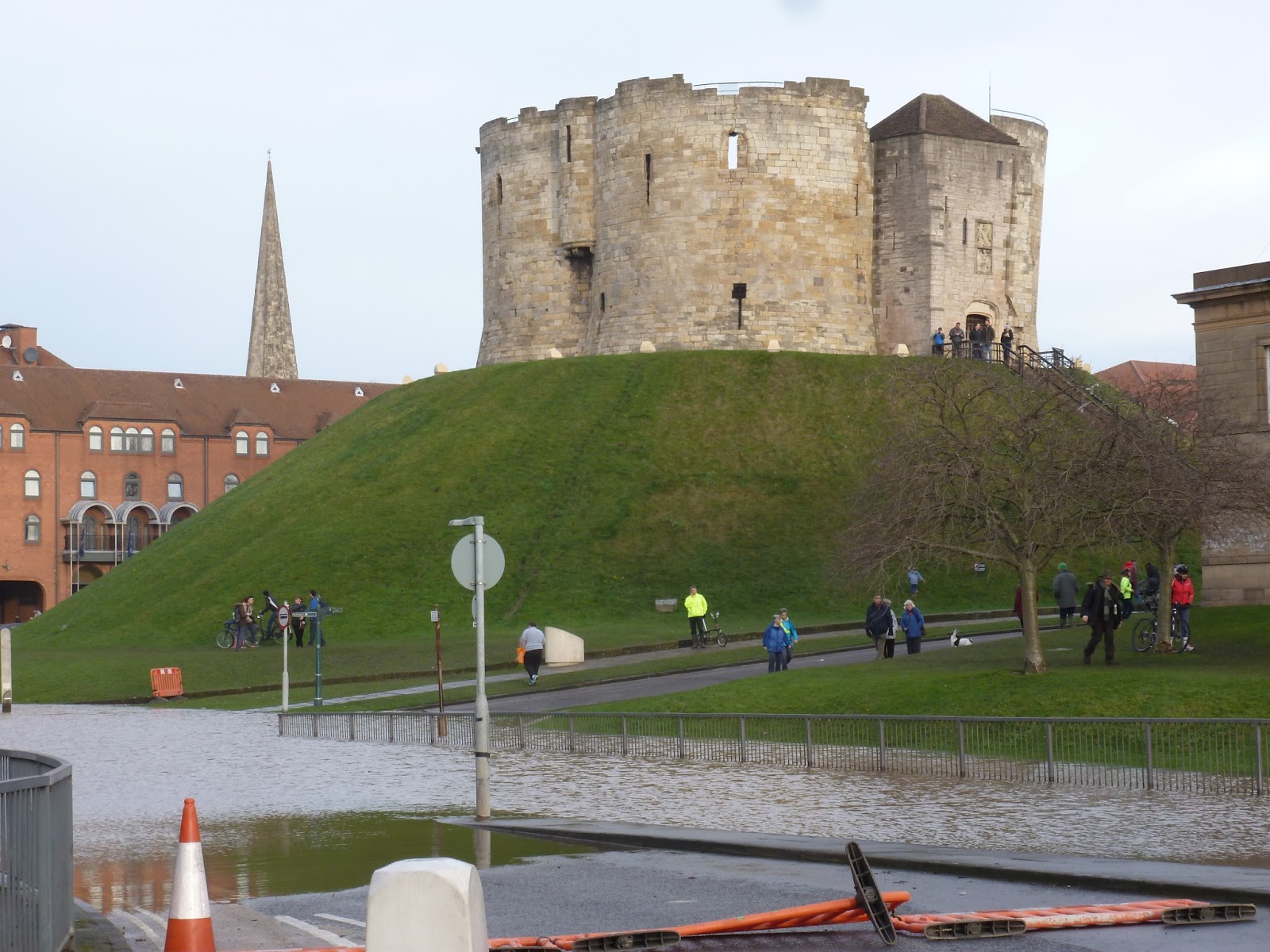
York Floods

I love my city. This Christmas it has been all over the telly, and for all the wrong reasons.


We were lucky. So many - thanks to the catastrophic failure of the Foss flood barrier - were not.

This is how near the river came to our house


Because a) York folk are who they are and b) the telephone exchange flooded and cut off all our phones and internet, people went out on to the streets to see what they could do to help each other.


The army were incredible, delivering thousands of sandbags and lifting in spare parts to the Foss flood barrier by Chinook helicopter.


The kindness of strangers has been humbling and heartwarming. Farmers drove to our street late at night, delivering a pump to a family battling to keep the Ouse out of their house.

David Cameron turned up in wellies and denied he or his government's policies had in any way contributed to the problem.

Shortly before Dave got there

Now we are on the eve of Storm Frank.

The bridge in Tadcaster has just collapsed.

I don't know how much more the people can take.

Just hoping we all get through this.


Monday, 21 December 2015

Back In Time For Christmas


My favourite TV family of the year - the Robshaws - came back for two Christmas specials. Hooray!

To explore Christmas dinner, obviously, and how it - and the day itself - changed between the 1940s and 1990s. For each decade they moved to a different house that looked the part in its furnishings and architectural design. With the odd added grand piano.

They start off in World War II. They have to make their own Christmas tree out of scraps of wood and paint it green. They also have to make their own Christmas presents - a spinning top, a seed driller, and sticky carrot fudge. They are given asbestos snow to play with. (Well, not really, but pity the poor 1940s sods who genuinely were.) Dinner is stuffed ox heart. Dad Brandon looks relieved to be called up for Home Guard duty immediately after it is dished up. Pudding looks like our "traditional" family recipe, which includes carrot, apple and potato. Ours is delicious, but the Robshaws' is somewhat spoiled when the girls make a sauce for it that mistakes salt for sugar. Still, at least it means their extra Christmas sugar ration will last into January.

And then - since we are in the Blitz - it's off to the local air raid shelter, where Lionel Blair is waiting. Brandon excitedly gets out his ukelele and they have a little sing-along while Lionel reminisces about performing on Piccadilly Line platforms as a boy. The air raid siren still sends a chill down his spine. The bombing stopped for Christmas in December 1940, but it could hardly have been construed as Peace on Earth in London that year. 100,000 incendiary devices were dropped on the city just a few days later. The stress must have been unbearable. It puts the scrum of panic-buying parents desperate to get their hands on a Tinky Winky 60 years later rather in perspective.

In the 1950s, the Robshaws get a real tree, albeit a slightly threadbare one. Rationing is over. The house is light and colourful - the blackout curtains, and the gloom, have gone. There is a cocktail party, where Rochelle serves canapes of anchovies, olives and Spam, washed down with Snowballs. The olives have apparently been popularised by an influx of Italian migrants. The Spam (opened by the world's scariest tin opener) presumably hasn't. On Christmas Day the family - like most would have done - go to church. They eat ham and tinned peaches for dinner, wheeled in on the world's wobbliest trolley. Mum is given a new pinny, the girls get books on ladies etiquette and "old lady" scarves. Then (while Mum does the washing up) the boys head off on the bus (yes, the bus, on Christmas Day!) to a football match. Apparently the last full bus service on Christmas Day was in 1979. By then the traditional Christmas Day footie matches had moved to Boxing Day. The Robshaws also see the Queen's first Christmas television broadcast.


In the 1960s, the house and hair go all Mad Men on us. It may be properly cold out (ice skating and everything), but there are plenty of luxuries inside as it is boomtime. The Robshaws get their first artificial tree and go to the panto, which in the 1960s would have starred the likes of Cliff Richard or Sid James. They have to make do with Christopher Biggins in Greenwich. Turkey makes its first appearance at the dinner table, thanks to factory farming making it affordable. For presents, they give each other cigarettes. Even the kids get smoking-themed chocolate. Rochelle also gets a new hoover, and Fred the son a Johnny Seven full weapons kit, which just looks so wrong through 2015 eyes. Brandon is very jealous.

This wish-fulfilment for the adults continues into the 1970s, when Giles Coren (dressed as Santa) finally gets the Evel Knievel toy he so coveted as a boy. (It turns out to be a bit of a disappointment.) The amount of presents being given has risen sharply, and the children choose their wish list from the Argos catalogue - a Polaroid camera, a chopper bike, a lava lamp. (Man, I LOVED the Argos catalogue as a kid.) Though Fred is unimpressed when what he is actually given is a Battleships game, deeming it to be far too "Boring!". The 1970s games of Frustration and Mastermind and an Etch-a-Sketch get a warmer reception, though mostly from the nostalgic adults. A pop-a-matic dice! But nobody can remember what exactly was frustrating about Frustration. Can you?

All this despite the 1970s being another time of austerity, with frequent power cuts and the government urging restraint on the Christmas lighting.

The 1970s were also when the race for the Christmas number one started. The Robshaws go to meet David "Kid" Jensen, the only 1970s DJ still allowed to appear in public, at a record shop. When they get home they dance to Slade's Merry Christmas Everybody. More shivers down the spine, but not quite the same level of dread. Brandon wants to learn the chords on his ukelele. He certainly has some dance moves.

Real trees are back in vogue, now they have been sprayed with fire-proofing chemicals. But the tinsel is out of control. And ooh, those garlands. We had loads of those in our lounge. So bad.

The turkey for dinner is now frozen, which results in days of defrosting in a bucket and a much higher risk of food poisoning. "Maybe I won't have any," says Mum Rochelle, "In case anyone needs medical assistance." On the plus side it means that the sprouts are pre-prepared and frozen too, saving Rochelle much time in the kitchen. Sprouts it seems are the only constant of dinner every decade. As is Rochelle being in the kitchen. And goodness me, they are eating off the same circular white dining room table that we had at home!

Still very much in use in the 1980s

The 1970s also sees the first starter at Christmas dinner - deep-fried avocado stuffed with Brie. There are 4000 calories in the dinner - in the 1970s we ate 40% more saturated fat than we do today. There is a deep fryer actually integral to the kitchen. The house is full of nibbles - chocolates, sweets and nuts, so that people can graze all day. Time to veg out in front of the television - but only three channels to choose from, all showing comedy. Mike Yarwood, The Two Ronnies, and a Morecambe and Wise classic that got 28 million viewers when first broadcast and still makes us laugh today.

The 1980s mark the switch from comedy classics to the soap opera cliffhanger on Christmas Day. "Merry Christmas, Ange!" snarls Dirty Den as he serves up her divorce papers. The Robshaws go off to meet Pat Butcher/Evans in the Queen Vic. She says that seeing everyone being miserable in EastEnders helps people put their own problems into perspective. As does seeing people starving in Ethiopia on harrowing news footage presented by Michael Buerk. The images still shock today. As do the appalling haircuts on the Band Aid video.

My second ever single. I won't admit to the first.
Back in their "squishy and pink" 1980s house which is big enough for their shoulder pads and hair, exotic fruit is on the menu. Mango! Kiwi fruits!


The house is now supposed to be decorated according to a theme suggested by a magazine. The Robshaws choose one in Tory blue. For gifts, there are executive toys, fluorescent earrings, power beads, Trivial pursuit and a genuine fur coat. "It's the dog!" wails Rochelle. And the family get their first computer. Just like our BBC Micro B, plugged into the television. They rustle up a turkey salad and a trifle using the aforementioned exotic fruits. But somebody forgets to make them taste nice. "Underwhelming," complain the teenagers, to the sound of the Pogues.

Home sweet home


Finally the Robshaws are back in their own house for the 1990s. The Christmas season is getting longer and starting ever earlier. The Spice Girls switch on Christmas lights on Oxford Street in November. And people are switching on lights outside their homes as well as inside.

An average of 135 pounds is being spent on presents for each child. Most of it on credit cards. The stocking, still there with its tangerine, is now mostly an aside to the enormous games consoles being bandied around as gifts. The Robshaws say they are going to need a new house to store all the presents: it's too much.

A billion Christmas cards are being sent every year. The first e-Card appears in 1992, but as only about 20% of households have internet access at the end of the 1990s, most still rely on the traditional envelope in the post. The Robshaws sit and type their first "round robin" letter on the computer. They get into the spirit of the thing, telling big show-offy lies about how great and successful they are. They are of course great and successful - they have their own TV series for starters, although they don't mention this. Instead the letter starts with "We had a big extension with a lovely patio" and ends with "Brandon won Eurovision". And they pity the recipients for their lesser achievements.

Gary Rhodes turns up to cook the Robshaws a Christmas breakfast - Eggs Royale. The Christmas dinner comes from a massive supermarket shop (plainly not being done on Christmas Eve since the supermarket is empty and civilised). The 1990s is the decade when everyone's Christmas dinner starts to taste the same, as more and more people rely on all the trimmings (and there are a lot of trimmings) being ready-made and mass produced. Only unlike in the 1970s or 1980s, it all tastes pretty good.

Depressingly, most Brits name drinking as their favourite Christmas activity.

Mulled wine for Mummy

And Amontillado for Santa

Mum Rochelle claims at the start of the show that she is not a fan of Christmas as she finds it stressful. Taking it back to simpler times when it was just a short-term holiday rather than something vastly overcommercialised that lasts for weeks takes the stress out of it. It also shows us how to appreciate it more, and to see the traditions that lie behind everything we do today. Brandon says that every decade has has its own social problems - war, power cuts, unemployment - but that Christmas is always a light shining in the darkness to give people something positive to focus on.

And it ends with them dancing in the snow. We always want snow. "I'm dreaming of a white Christmas..." Our daughter EXPECTS a white Christmas. She was sorely disappointed last year and I expect this year will be the same. She will be the one shouting her parents out of bed early in the morning, just like the Robshaw children.

Saturday, 5 December 2015

The Bridge/Bron/Broen III

Hollow talking and hollow girl
Force it up from the root of pain
Never said it was good, never said it was near
Shadow rises and you are here
And then you cut
You cut it out
And everything
Goes back to the beginning

I remember visiting a family in Denmark in 1990 who over dinner told me of the plan to build a bridge between Copenhagen and Sweden. This completely blew me away. Build a bridge over the sea? Really? It seemed preposterous. Unbelievable. Remember that this was a time before the Channel Tunnel opened. Plus my geography was more than a little skewed and I had no idea just quite how near the south of Sweden was to the Danish capital. I imagined gigantic suspension arches strung sky high across hundreds of miles of ocean waves, with a road flailing to and fro in the air between them. Which wasn't quite what they had in mind. Obviously.

The double-decker High Level bridge across the River Tyne
is in the background
Nonetheless, the Oresund Bridge, which was finished about ten years later, is an undeniably impressive structure. It's double decker for starters - top deck for cars, bottom for trains. (Though Robert Stephenson did this first in Newcastle in 1847, with the trains on top.) And it does have a couple of very tall suspension towers, even if they aren't quite on the scale I imagined. But it doesn't actually go all the way across the strait - only as far as a manmade island in the middle, then it plunges into the water to become a tunnel, which looks more than a little freakish when viewed from the air. This is presumably to prevent planes landing or taking off from nearby Copenhagen Airport crashing into anything.

I have never seen The Bridge in the (concrete) flesh, only on the television series it has given its name to. And thanks to The Bridge, I am not sure I ever want to see it. Or even go near it. A lot of terrible things happen on that bridge. Boat collisions. Shootings. Corpses severed in two. A mustard coloured Porsche permanently speeding across it.

How did the Copenhagen and Malmo police cooperate before the Bridge was built? Did they row across the water to meet up? Or take a helicopter? Maybe they just phoned each other. Or perhaps they didn't need to cooperate at all, since if there was no Bridge, it probably meant that people didn't keep getting murdered on each other's soil.

But anyway, here we are again, our addiction fuelled and our Saturday nights once more lost to Saga Noren. The background's washed out to match her Porsche. There's another set of grisly, creepy murders to solve, involving mannequins, missing body parts, scarecrows, spotlights and lipstick. No sign of a Michael Gove look-a-like suspect this series yet, although there are gangsters, gamblers, vloggers, art collectors, surrogate babies and a scary stalking undertaker. And no sign of Martin either, since Saga got him sent to prison at the end of series two. I miss him, the great, flawed cuddly Danish bear that he was. His immediate replacement - a grumpy woman called Hanne who reminded me of Hanne Holm in Borgen - was quickly blown up by a caravan. The second - pill-popping insomniac Henrik - is lingering a little longer. He has a shirt that matches Saga's car. He seems to see dead people in his house, like Bruce Willis before him. He has also introduced Saga to the Copenhagen singles club scene. They wear green stickers begging FIND ME, though Saga's attempts at pick-up lines ("Do you want to have sex?") make these seem comparatively subtle.

The Little Mermaid

We are finding out more about Saga's past in this series. The mother with Munchausen By Proxy alluded to in Series 2 turns up to tell Saga her father is dying. She is armed with medical files which supposedly prove her innocent in whatever want on during Saga's childhood. But I don't really want to know. Just like I don't want to know exactly what part of the autistic spectrum Saga is meant to be on, if she is at all. I just want Saga to be Saga and do what she does best - working too hard, adhering to police protocol, making blunt remarks, finding poison in coffee cups, and unmasking killers called Gertrud. May she hold it together despite all that is being thrown at her this series (two dead parents - yes, two now, a lot can happen in the span of a single paragraph! - ill boss, crap new boss, her competence brought into question) so that long may she reign.

Dodgy summerhouse in Swedish woods,
where mosquitoes commit crimes against humanity

Friday, 4 December 2015

Capital


It was always in the back of my mind that I wanted to write a novel about the people living on a typical 21st-century London street. Unfortunately, John Lanchester beat me to it. No great surprise, since anything at the back of my mind is invariably sat in a swamp of inertia, like the dirt behind the fridge or those pictures that never get hung on the wall. Kids happen. Novels don't. So I can hardly be cross that someone else had the same idea as me, poured themselves a coffee, sat at a desk, turned on their computer, opened a blank Word document, typed out a story and got it published. Especially as they did such a mighty fine job of it. Capital is a rollicking read, full of well-drawn characters who are in turn funny and poignant, likeable and unlikeable, rich and poor. They are either foreign to, adopted by, or born and bred in that magnificent melting pot of cultures that make London so special - and so frustrating.

A typical London street?

Corner shop

There's the Polish builder. The out-of-touch banker. The banker's ghastly spendaholic wife. The Eastern European nannies raising the banker's children. The exuberant corner shop family with the matriarch in Pakistan. The parking official posting tickets onto Range Rovers, an asylum seeker working illegally. Her gospel-singing boyfriend. The policeman accused of being racist by one side of the street and overly politically correct by the other. The old lady who's lived there for 60 years and long been priced out of the property market. The old lady's distant daughter seeing the pound-signs on the walls of her inheritance. The old lady's grandson, a Banksy style street artist. There's also - in the book - a Premiership footballer, but it seems that they couldn't afford his transfer fee to television.

We want what you have?

For yes, now there's a mighty fine television adaptation of Capital to enjoy too, with a brilliant cast and the atmosphere of the novel captured perfectly - the greed, the anger, the sadness, and the different senses of family, whether close, distant, interfering, aloof, loud, or lonely. There isn't much joy - a pilates class for Arabella, a hot date for Bogdan, a curry round the Kamal family table - and what little there is seems to always have a darker, bitter side. And yet somebody is sending every resident on Pepys Road postcards saying "We Want What You Have", and photographing their windows and doors. They are indeed enviably beautiful doors of stained glass, with porches and paths of Victorian tiles. Who wouldn't want to afford one of their own on a desirable Clapham street, just round the corner from the Common, the cafes and the Tube?

I have been known to go round photographing London doors and windows
But if the sender of the postcards is desiring wealth, then take heed, for the most moneyed residents are definitely not happy with their lot. The banker, Roger Yount, finds his world is slowly unravelling. It all starts when his bonus is a mere 30,000 pounds, as opposed to the two million that he was predicting and that his wife Arabella was already spending on renovations. "What on earth can anyone do with 30,000 pounds?" he roars at his dour German boss. (Well, if it was me, quite a lot actually.) Arabella refuses to believe that they may need to cut costs on such essential items as second homes, prep school fees and pomegranate molasses, and takes herself off to a spa for Christmas, leaving Roger alone with the children, their poo, their Lego and an unexpected sofa delivery. Although it's nothing that a quick call to a nanny agency can't resolve.

But the postcards may be wreaking havoc with the property prices (currently spiralling upwards literally in front of our eyes as the months go by). And Roger's upstart junior has also hacked into the bank's systems and is doing some dodgy trading which can only lead to crash. Crash and burn.

Clapham Old Town, where I rented a room for half my salary

Clapham High Street


There is drone footage of familiar South London suburbs - Clapham, Wandsworth, Balham, Streatham - and their avenues of plane trees, their commons and lidos. There is a double decker bus on Tooting Broadway, an MRI scan at St George's Hospital. There are ice creams in Battersea Park, near the Peace Pagoda and Albert Bridge. And a Merry Christmas wished between strangers on the greenest Clapham Common I have ever seen in the depths of winter. with the trees in full foliage. That's global warming for you.

Clapham Common in full foliage

For me, it always was the green spaces like Clapham Common that made London bearable. Otherwise you find yourself craving, if not screaming for, the countryside. It seems you cannot spend your life without grass. If you can't afford that second home in the country, then eventually you move away to the country. But you will very possibly long to return to London, our great Capital, as soon as you get there.