Showing posts with label Scandi Noir. Show all posts

Monday, 29 February 2016

Trapped


I'd write a lot more about Trapped if I hadn't just written about Fortitude. Fortitude kind of stole Trapped's thunder. Which is a shame, because despite certain similarities, Trapped is far better.

I used Fortitude as an excuse to write about Iceland, since the majority of Fortitude was filmed there. Whereas Trapped is Icelandic through and through, born and bred, in word and image. It's set in a seaport as remote as Fortitude. (It's possibly even the same seaport used in Fortitude.) A torso is found in the water just as a ferry docks from Denmark. Then a snowstorm hurtles in, cutting off the community and leaving everyone trapped, with a murderer possibly still in their midst.


Five episodes in, and the town has no power supply or phone network after an elderly delinquent set off an avalanche. The only people still with light are the sailors on the ferry; everyone else has cosy candles. But the geothermal activity is keeping the swimming pool and sports hall heated and the showers steaming hot. For now.

As in Fortitude, there are sexual shenanigans, slightly feral children, corrupt politicians, ambitious redevelopment projects, actors from The Killing, women who never wear hats in snow, bad fish, illegal drugs, revolting things happening in sheds, dodgy foreigners, and brooding policemen with issues. The latter, Andri, a great big bearded bear of a man, has apparently become a sex symbol. Cuddly, yes, but sexy? Well, there never has been much accounting for taste. But you do like him, and want him to find happiness. He still wears his wedding ring, but his ex-wife has moved on so far that she thinks it's perfectly OK to come to stay with him and their daughters with her new partner. Andri must be grateful for the distraction the murder then provides.


The police department is as small and isolated as the one on Fortitude, and the HQ in Reykjavik can't get any reinforcements through. The coppers are not incompetent, but would surely save themselves a lot of hassle (death, injury and theft, for example) if they could just get their holding cell kitted out with a potty.

That said, it seems the local community know more about what is happening in the case than the police. Even after Twitter crashes. I am not quite sure who the mole is, but everybody knows everybody's business without anyone seemingly being told. It's like the facts osmose through the ether, or through the pipes like all that geothermally heated water. Maybe the information comes from the old guy in the wheelchair, who spies on the town through a telescope in his farmhouse up on high. He sees the mayor beating and raping his wife, the town bureaucrats arguing, the policewoman offering the trafficked African girls a safe haven, and her husband growing weed.

I hope that Trapped will carry on in a similar vein, slow-paced but gripping. There is much left to reveal, and I trust that it will be, as the darkness returns to light. There's not only the current murders, but also the past too - who set the fire that killed Andri's wife's sister and maimed her boyfriend? Is it the same arsonist who just did for the mayor in his shed? Only please let the explanation have nothing to do with parasitic wasps.


Monday, 1 February 2016

Fortitude

This was our latest Scandi Noir murder mystery box set. Except it ended up quite a different kettle of (fermented) fish. At first it seemed like a straightforward whodunnit with added snow and thermals, but then it turned into a haunting nightmare of feral children, disembowelment and prehistoric wasps. It didn't hold back in the packing of its punches or the releasing of its blood.
I was attracted by the high calibre cast, but it seemed the director wasn't afraid to kill even the most famous of them off at the drop of a woolly glove. Or woolly mammoth. Christopher Eccleston didn't even last the first episode. Stanley Tucci and Michael Gambon stayed longer, but fell well before the saga's end. Sofie Grabol, sounding rather awkward in English, did live to see another day, but her ice hotel had been shelved, her marriage wrecked and her community left in tatters. Richard Dormer was similarly whole physically - but mentally in bits.

The remote Arctic Circle community was chock-a-block with multi-national weirdos. There were a lot of "issues", and people running away from past demeanours. It's quite surprising that Fortitude had such a low crime rate before the TV crew rocked up, given the large amount of guns knocking about this group of cranks. The folk of Svalbard occupied themselves with hunting, feeding each other, and swinging. According to Stanley Tucci, a home where the latter is welcome is signified by wind chimes tinkling outside. I didn't know that. The previous owners of our house left a big wind chime "swinging" in our back yard, you see, so this revelation made me rather worried. Thankfully it seems the other residents of York are as ignorant of the wind chime's double meaning as me.

Wind chime swinging

The scenery in Fortitude was stunning, especially when the polar bears turned up. But the performances were often stilted (not by the polar bears) and the plot slow burning. But despite the sedentary pace, some facts about certain characters weren't spelled out clearly enough. Because of all the swinging, I couldn't always get to grips with who was sleeping with whom before it became critically relevant. And everyone starts to look the same when muffled to the nines.

This polar bear lives in Doncaster

The DVD extras revealed that the series was actually filmed in Iceland rather than Norway. The crew went to a place where they thought they would have guaranteed snow (the clue perhaps in the name) but they ended up having to import snow from London, where they'd all just come from.


I spent a crazy few days in Iceland in July 2000, although in comparison to the shenanigans in Fortitude, "crazy" is probably too strong a word. It felt crazy at the time though. I was with a Danish friend who was - in short - a lot more free-spirited than me. I definitely cramped her style for a few days. She wanted to hitchhike; I insisted on taking the bus. She wanted to wild camp on swamps, I wanted a toilet that wasn't a hole in the turf. (I'm sorry, I just don't do well without plumbing.) She was on a student budget, hence the need to live in a tent. Although I was hardly rolling in money myself. Iceland is very expensive. It would be nice to go back with a bit more cash in my pocket. I have no idea when that will be. (Although the country has since gone bankrupt so maybe my pounds would go further now.) We ate porridge oats, raisins and water for breakfast and steamed dried fish and lentils for tea. On the last day we treated ourselves to lunch in a cafe in Reykjavik and for dinner - having been granted use of the kitchen in the youth hostel next to the campsite - we cooked lamb steaks, washed down with a bottle of cava we'd splashed out on in a state liquor store. It would have been red wine until we remembered - in the days before the screw-top bottle became ubiquitous - that we didn't have a corkscrew.

Under canvas, I craved a night in a house like this

The weather was nearly as wild as my friend's ambition - for even in the height of summer, the wind was searing and the rain relentless. Thankfully I had invested in new waterproofs, and they came into their own. I'd foolishly taken a torch along - no need for that in Iceland in July as it didn't get dark. I remember reading Harry Potter in my sleeping bag until nearly midnight.

Waterproofs and hat still necessary in a rare moment of sun
if only to camouflage yourself against the lighthouse

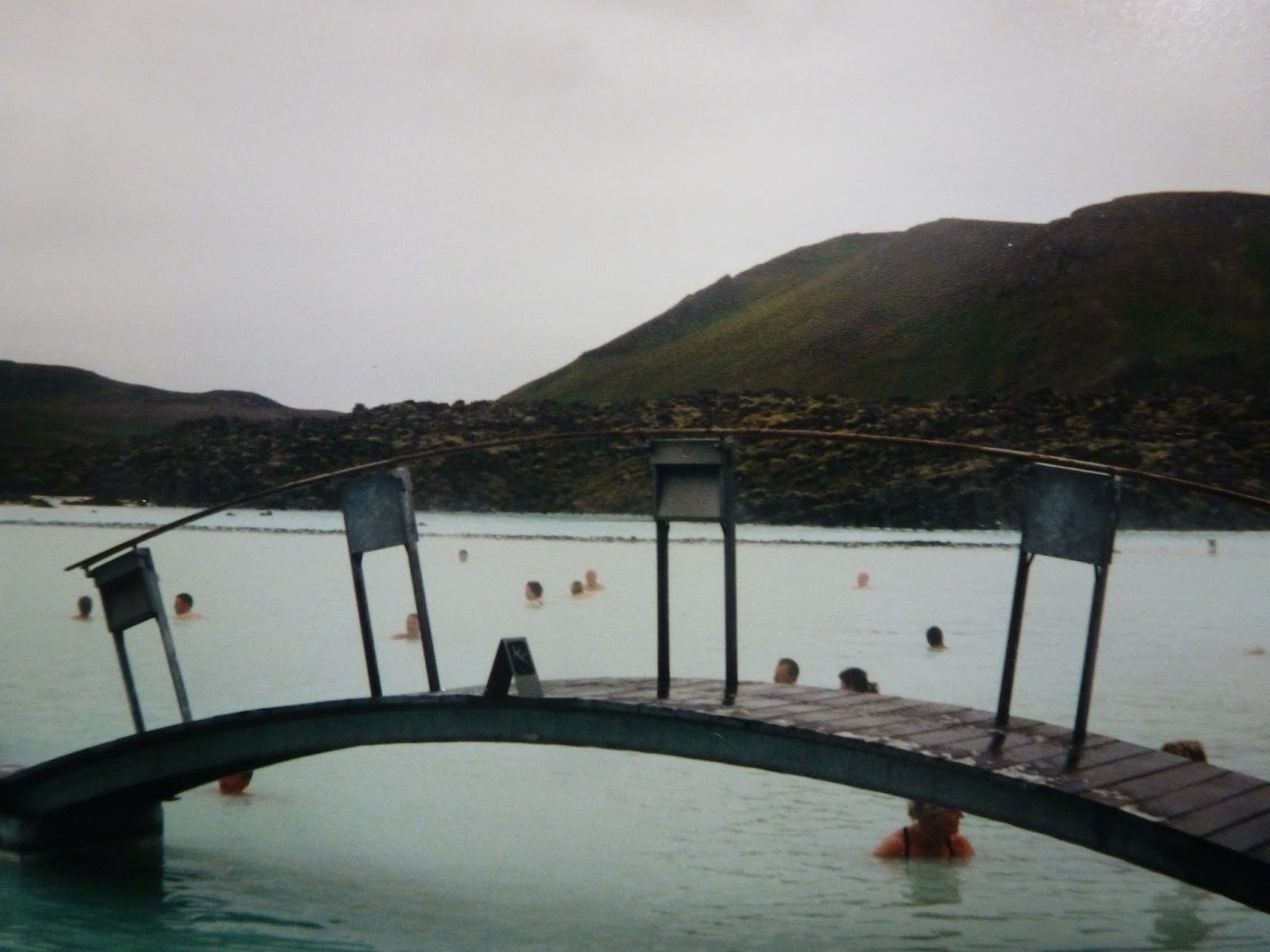
We spent a couple of days in and around Reykjavik. We bathed in the Blue Lagoon amongst the lunar landscape of lava fields and industrial effluent of Keflavik. I took myself on the "Golden Circle" coach tour to see the waterfall at Gulfoss and the geysers at Geysir, which couldn't have looked any less golden in the deluge.

Blue Lagoon

Gulfoss

We then headed up to Stykissholmur for three nights. I loved it there - a small fishing community of brightly coloured houses and a space-age church, where the air was the purest I have ever known. There is so little pollution in Iceland - there aren't many cars, and no fossil fuels are burned as they get all their power from geothermal activity. This means that the aforementioned plumbing can smell rather sulphurous. But it feels good.

Stykissholmur


Space-age church


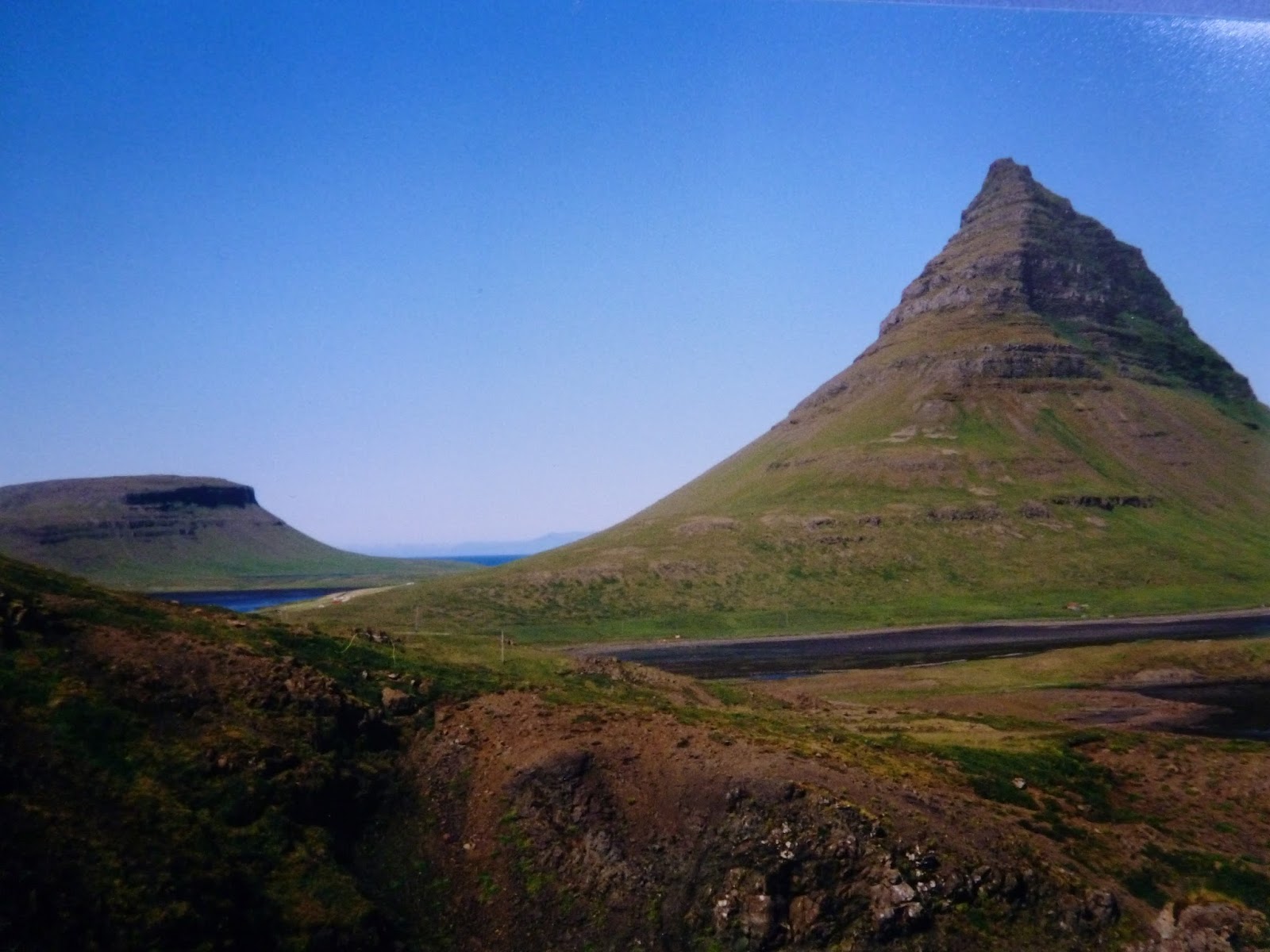
We went hiking at Grundarfjordur, which had a spectacular needle-point mountain, a babbling brook and no trees. My friend insisted that our luggage would be safe simply left dumped in a petrol station forecourt. Living in crime-ridden London at the time I had my doubts, but she was right. It was Fortitude as it should have been. With or without the swinging.


Grundarfjordur

Saturday, 5 December 2015

The Bridge/Bron/Broen III

Hollow talking and hollow girl
Force it up from the root of pain
Never said it was good, never said it was near
Shadow rises and you are here
And then you cut
You cut it out
And everything
Goes back to the beginning

I remember visiting a family in Denmark in 1990 who over dinner told me of the plan to build a bridge between Copenhagen and Sweden. This completely blew me away. Build a bridge over the sea? Really? It seemed preposterous. Unbelievable. Remember that this was a time before the Channel Tunnel opened. Plus my geography was more than a little skewed and I had no idea just quite how near the south of Sweden was to the Danish capital. I imagined gigantic suspension arches strung sky high across hundreds of miles of ocean waves, with a road flailing to and fro in the air between them. Which wasn't quite what they had in mind. Obviously.

The double-decker High Level bridge across the River Tyne
is in the background
Nonetheless, the Oresund Bridge, which was finished about ten years later, is an undeniably impressive structure. It's double decker for starters - top deck for cars, bottom for trains. (Though Robert Stephenson did this first in Newcastle in 1847, with the trains on top.) And it does have a couple of very tall suspension towers, even if they aren't quite on the scale I imagined. But it doesn't actually go all the way across the strait - only as far as a manmade island in the middle, then it plunges into the water to become a tunnel, which looks more than a little freakish when viewed from the air. This is presumably to prevent planes landing or taking off from nearby Copenhagen Airport crashing into anything.

I have never seen The Bridge in the (concrete) flesh, only on the television series it has given its name to. And thanks to The Bridge, I am not sure I ever want to see it. Or even go near it. A lot of terrible things happen on that bridge. Boat collisions. Shootings. Corpses severed in two. A mustard coloured Porsche permanently speeding across it.

How did the Copenhagen and Malmo police cooperate before the Bridge was built? Did they row across the water to meet up? Or take a helicopter? Maybe they just phoned each other. Or perhaps they didn't need to cooperate at all, since if there was no Bridge, it probably meant that people didn't keep getting murdered on each other's soil.

But anyway, here we are again, our addiction fuelled and our Saturday nights once more lost to Saga Noren. The background's washed out to match her Porsche. There's another set of grisly, creepy murders to solve, involving mannequins, missing body parts, scarecrows, spotlights and lipstick. No sign of a Michael Gove look-a-like suspect this series yet, although there are gangsters, gamblers, vloggers, art collectors, surrogate babies and a scary stalking undertaker. And no sign of Martin either, since Saga got him sent to prison at the end of series two. I miss him, the great, flawed cuddly Danish bear that he was. His immediate replacement - a grumpy woman called Hanne who reminded me of Hanne Holm in Borgen - was quickly blown up by a caravan. The second - pill-popping insomniac Henrik - is lingering a little longer. He has a shirt that matches Saga's car. He seems to see dead people in his house, like Bruce Willis before him. He has also introduced Saga to the Copenhagen singles club scene. They wear green stickers begging FIND ME, though Saga's attempts at pick-up lines ("Do you want to have sex?") make these seem comparatively subtle.

The Little Mermaid

We are finding out more about Saga's past in this series. The mother with Munchausen By Proxy alluded to in Series 2 turns up to tell Saga her father is dying. She is armed with medical files which supposedly prove her innocent in whatever want on during Saga's childhood. But I don't really want to know. Just like I don't want to know exactly what part of the autistic spectrum Saga is meant to be on, if she is at all. I just want Saga to be Saga and do what she does best - working too hard, adhering to police protocol, making blunt remarks, finding poison in coffee cups, and unmasking killers called Gertrud. May she hold it together despite all that is being thrown at her this series (two dead parents - yes, two now, a lot can happen in the span of a single paragraph! - ill boss, crap new boss, her competence brought into question) so that long may she reign.

Dodgy summerhouse in Swedish woods,
where mosquitoes commit crimes against humanity

Tuesday, 10 November 2015

Broadchurch

Yes, I know, we are three years behind the rest of you. Sorry. That's our Lovefilm subscription for you, and my fault for missing it on television in the first place. And by the time the Broadchurch discs finally landed on our doormat, I had accidentally found out whodunit from a careless comment by a television reviewer in the Guardian. (Spoiler alert next time, please!) So I was in two minds about whether I should bother watching it after all. But anyway, I did and here we are.

This is ITV's attempt at Scandi Noir. The music is almost copied and pasted in from its Danish forebears; it's too similar to be a coincidence. (Although they would probably prefer to use the word "influence".) We have no quick resolution but instead eight episodes to draw us in, befriend the community, and see the consequences of the tragic events unfold. We don't just get to know the police investigators and the victim's family, but also the wider world at large - the journalists, the vicar, the caravan park cleaner, the plumber's mate. We have to sit through a bunch of red herrings, as each episode focuses on a different suspect before the killer is finally revealed.

But it's not as good as The Killing or The Bridge. We are definitely on ITV rather than BBC4. Somehow detective musings don't work as well in a West Country burr as they do when full of Copenhagen phlegm. And the sun was shining all the way through the first episode, which seemed wrong. But as the story progressed, the rain set in. This was Dorset, after all.

Do all coppers have a brooding and complicated back story? Is this why everyone is so rude to them in television dramas - the police have become so ineffectual in their misery that they can no longer afford respect? Have some sympathy, Joe Public. Besides, even if you are a character on a TV show, shouldn't you be just a little bit scared of someone who has the power to chuck you in a cell if you don't play your cards right? Because being surly, dismissive or just plain unhelpful is definitely not playing your cards right, in my opinion.

And why does everyone have an instant alibi spring to mind? I can't remember what I did yesterday without checking my diary, but these potential suspects can immediately say where they were and what they were doing to the nearest second as soon as they are asked, even if we are talking about weeks before. Although in this particular case, as the body was dumped on the beach in the middle of the night and I don't have much nocturnal fun any more, I would have been 99.9% sure to have been in bed. Whether or not I'd have been asleep would have been in the hands of my five-year-old. And I bet she would be unable to confirm my alibi without growling at the police officer. (I wish she would stop doing that.)

Apparently, the writers of Broadchurch didn't tell the cast who the murderer was before they filmed the final episode. So every actor was going through the whole thing not knowing whether it was them. While this is kind of a good idea for the innocent parties, surely you have to tell the actual murderer? Otherwise how can an actor give an accurate performance if they don't know they have something to hide? As I knew from the start who it was, I watched their character closely from the get-go. And they always seemed a little too innocuous and complacent given the torment they were in at the end. It was too much of a personality transplant in the last hour of the series. But of course it always has to be the person you suspect the least, just like in the days of Agatha Christie.

Most of Broadchurch was filmed in West Bay on Dorset's Jurassic Coast, and we were there in August, despite not having seen Broadchurch at the time. It was a drizzly, grey day and we almost had the beach to ourselves. In the gloom, West Bay looked exactly like the sort of desolate community where a misfit murderer might lurk. It was rundown and sad. The sea was hidden from the car park by an enormous pile of gravel. Other than a quirky antiques-centre-slash-street-food-emporium, it was a melancholy collection of shabby hotels, chandlers and charity shops. The surprisingly snazzy Broadchurch police station was a property redevelopment on the quay that looked empty and out of keeping with the rest of the town.

It might have all looked rather more appealing in better weather. Indeed those cliffs in the sun on the first episode of Broadchurch looked absolutely stunning, despite having a dead boy at the foot of them. In the rain, they looked fit to crumble. Which of course they are.

She would not confirm my alibi


The site of the dead boy

The police station on the quay.


Jurassic Coast

Friday, 22 May 2015

1864

Seebüll, Schleswig-Holstein, Germany
Why does Denmark have such a small number of actors? Is it because the majority of Danish people think it's more important to do "real" jobs like dentistry and teaching and farming? Or are casting agents just really lazy?

So here is a new period drama about the Schleswig Holstein wars in the 19th century, but it's full of the cast of Borgen. (And at least two of them were also in The Killing.) Søren needs clematis for a leg wound. Kasper explains his bad haircut in season three. Birgitte is performing Lady Macbeth. Torben isn't in the first episode, or at least not in the bits I stayed awake for, but he is in the trailers.

So yeah, I kind of ended up skim-watching it on iPlayer while falling asleep. The whole thing didn't really engage me, sorry to say. I nearly turned off at the jar of sperm. Maybe enough people weren't being murdered on screen to justify its Saturday night BBC4 slot. (Though plenty were being slaughtered off it. Kasper claims he's killed 120.) Maybe there weren't enough newscasters or spin doctors. Maybe I am too much of a modern day history student, like the ones showed rolling their eyes in front of a windmill before going off to smoke a spliff.
But I do have a soft spot for the whole Schleswig Holstein-Southern Jutland area, having spent a couple of extended summer holidays there as a teenager. While there I heard lots of stories of the Germans' invasion of Denmark during the Second World War, so theoretically it should be interesting to learn about a time when Schleswig Holstein was Danish. But this apparently isn't how I want to do it.

The Danes' strained relationship with their neighbours was still in evidence 25 years ago, even if by then the only German invaders were driving Trabis over from the East in a bid to find a cheap holiday. The Danes did like running over the German border to buy cheap booze, although subsequent changes in EU Duty Free regulations may have curbed this since. But the older folk had sad recollections of the Second World War, and German concrete bunkers were still all over their islands and coastline, half-buried by the dunes and only then (in the early 1990s) being opened to the public for the first time.


The Danish flag flies proudly in everyone's back garden in South Jutland, a flag which is believed by the school master in 1864 to have fallen directly from God, as turned on its side it displays an image of the crucifix.


South Jutland is a landscape reclaimed from the sea. There are marshes and thatched red brick cottages.


The sand dunes are dotted with summerhouses, rosehips and buzzing horse flies.


Church steeples and wind turbines are the only height visible for miles across the level fields and mudflats.


The wide open beaches are covered in kite flyers in summer and gigantic jellyfish in autumn. They go on for miles.***


There may be no mountains but there are big skies, and it is peaceful and truly beautiful. The memories of my time there are complex - different relationship, different part of my life entirely, good things, bad things. I don't think it would ever be possible to go back there. Maybe this is why I couldn't get into 1864. Or maybe it is in fact just a disappointingly turgid, over-sexed period drama.

***Just watch out for the cars allowed to drive on to the sand. Oh, and the nudist section. Which ain't so pretty.

Saturday, 15 February 2014

The Restaurant Man - Scandimanic Macclesfield

Maybe that's enlightenment enough: to know that there is no final resting place of the mind: no moment of smug clarity. Perhaps wisdom...is realizing how small I am, and unwise, and how far I have yet to go." (Anthony Bourdain)

And suddenly there was not one but two Scandinavian themed food programmes in the same week. The Restaurant Man featured the opening of The Salt Bar, a Swedish themed establishment in the “cobbled quarter” (which looked significantly less romantic than it sounds) of Macclesfield. Restaurant Man himself Russell Norman rather shot himself in the foot when he declared in his introduction that there is little interest in Scandinavian food in the UK. But Hugh said the exact opposite on Sunday! Noma has been voted the best restaurant in the world at least once. Masterchef finalists were sent to work there one year. And - for that matter - has Russell never been in the jam-packed cafe in IKEA? Clearly not, since (speaking of jam) he also failed to spot restaurateur Debbie’s big fat typo on her menu in her spelling of lingonberry, which meant that Russell referred to it as ligonberry jam for the remainder of the programme. But I suppose that Russell doesn’t really strike me as the sort of person that needs cheap Billy bookcases and uplighters on an eternal Tower-of-Pisa-like lean in his lounge. He’s quite posh.

Actually, to call Debbie a restaurateur is a bit of an exaggeration. It’s certainly what she is aspiring to be, but her experience to date seems to have consisted entirely of two weeks’ bar work a very long time ago, which makes you wonder what on earth led her to believe she could set up and run a restaurant. It’s one thing liking good food, it’s another cooking it, and yet another cooking it for and serving it to 50 people a night, night after night after night. Especially when you haven’t actually written down a business plan or done any sums. It’s lucky that Debbie had a retirement nest egg to invest because no bank would have ever loaned her the money based on how few financial calculations she has done. “Show me some projected overheads or staffing costs.” Debbie’s lower lip instantly wobbles and tears loom in her mascara. Bless her, she means well.

Staffing costs? She was planning on running the whole place herself, with just one chef cooking in the kitchen, 12 hours a day, 7 days a week. Russell politely suggests that this may be illegal. Oh, he’s charming, that Russell. I dread to think how Gordon “Kitchen Nightmare” Ramsay might have made the same point.

But like all the people Russell is working with in this series, Debbie knows her food, and can cook well herself. This is some relief, but to have so little idea about what is involved in a restaurant service takes some doing.  Has she never been to a café before? (You mean people need cutlery? I should take their menus away once they’ve ordered?) If nice ladies like Debbie don’t get to eat out, then who in Macclesfield does? It is, as Russell points out, when disembarking from the train, a town of boarded up restaurants.

Debbie hasn’t done any market research either. It appears, when allowed to trial some of her signature dishes in another cafe, that people in Macclesfield don’t much care for salad. But the ladies at the local golf club are pleasantly surprised by beetroot on Ryvita.

Time ticks by, and the floor is still a pile of splintered wooden planks tossed randomly around. Debbie has also not realised that she might need a storage area for food and wine once she is up and running. Russell suggests she reduce the number of toilets from two to one in order to rectify this, but Debbie refuses to let the ladies share a toilet with the gents. It says a lot about the blokes in Macclesfield when Debbie says that men are, as an entire species, disgusting when drunk. She clearly also isn’t expecting people in the Salt Bar to skimp on the booze. Let’s hope she is planning on charging Scandinavian prices.

Time is ticking, yes, but as on every other week of this series, there’s still enough of it left for a nice exotic  trip. Last week, our gastropub gamers were taken up to shoot venison in Scotland. This week, Debbie got to serve up her vegetarian meatballs (a contradiction in terms, surely?) in a restaurant in Stockholm.


My husband and I got engaged in Stockholm. He proposed to me at twilight on the harbourside, with dozens of hot air balloons flying overhead. It is a beautiful, waterlined city that I shall always remember fondly, despite its unexpected humid July heat and monster mosquitoes on its archipelago. Debbie appears rejuvenated from her visit and miraculously pulls the rabbit out of the hat, or the gravadlax out of the cold-cure, and the restaurant opens on time, to very decent reviews on Trip Advisor. I love Scandinavian food and I wish her well. But she was astonishingly naive, at least if you believe everything you see on the telly. Thank goodness for Russell’s calm but forceful assistance, a rational and reasoned approach embodied perhaps in the silver tape measure he presents as a gift as he leaves.

Wednesday, 12 February 2014

In Search Of Happiness - Scandimania

Bohr: Heisenberg, I have to say - if people are to be measured strictly in terms of observable quantities...
Heisenberg: Then we should need a strange new quantum ethics.
(Michael Frayn, Copenhagen)
Sunday was a day of Denmark, for good and bad reasons. Firstly, Copenhagen Zoo killed a baby giraffe that didn’t fit its gene pool, and secondly, Hugh Fearlessly-Eatsitall visited the country in the second of his Scandimania series. Bad timing for Hugh, since everyone was probably too outraged at what had gone on earlier in the day in the same city to really be prepared to give his show much truck. And this despite Hugh’s Copenhagen airport transfer being by very environmentally friendly bike.

As with the first part of the series in Sweden (ABBA, lakes, paternity leave, state-owned liquor stores, elk), Scandimania in Denmark seemed to be one piece of stereotypical trivia after another. Danish pastries are called “Vienna bread” (wienerbrød)  in Danish. And they taste better (funnily enough) when hand-made in a specialist Copenhagen bakery rather than when baked in your local Greggs. The Danish make architecture that reflects their mountain envy. The Danish make good murder shows. The Danish have wind farms. The Danish have a world-class foraging restaurant whose owner, surprise surprise, is a mate of Hugh’s. The Danish pay a lot of tax. Hugh only left out a big box of LEGO and a side of bacon. I picked up a copy of the Time Out guide to Copenhagen for 50p in a charity shop last week and I learned almost exactly the same facts from a quick skim through. Oh, and Hugh was even staying in the one hotel room the guidebook has a photo of. (Room 606 at the Radisson Blu (SAS) Royal Hotel, designed by Arne Jacobsen. Nice work if you can get it.)

Hugh’s main focus was on the Danish concept of hygge (a very home-based kind of cosiness that has no literal translation) and the question of why (when assessed using certain statistical criteria) the blonde, healthy Danes are rated by the United Nations as the happiest in the world. He concluded that their happiness was to do with their sense of community and notion of trust. That they can trust each other and, more importantly, trust their government to spend their astronomical taxes wisely and provide for their every need. Well, who wouldn’t want Birgitte Nyborg to be their Prime Minister? (...What do you mean, she’s not real?)

When I first visited Denmark at the age of 17, I too was struck by how much the state provided. The daughter of a family I was staying with was just starting at an efterskole (a one-year boarding school for 18 year olds where they can explore their interests, develop their potential and have their first taste of independent living) similar to the one Hugh visited on his programme, and she took us to see her new accommodation. I couldn’t believe the gorgeous ground-floor studio flat she showed us, complete with her own kitchenette and shower room, where she was going to live possibly for free, or at least for massively subsidised rent. This was long before universities in the UK started smartening up their hall of residence accommodation and providing en-suite bathrooms for the conference trade (and therewith sending rents sky high). Long corridors of small rooms invariably modelled on an urban myth of a Swedish prison, communal showers, no fridges or cooking facilities, and one pay phone for 300 people was the norm back then.

The concept of hygge seems to involve large family meals and roaring campfires, a similar party atmosphere to the one Hugh always tries to create at the picnics which are the prerequisite end to all his River Cottage programmes. In this version of Denmark, the sun always shines. Just like in Hugh’s Dorset, which currently probably only has its highest hillocks peeping out from the flood.
Danish hygge, North Jutland


I have only visited Denmark in summer, so my memories of it are indeed of a very sunny place, of rolling tussocky sand dunes, marshy flatlands punctuated only by church spires and wind turbines, and big blue skies. But there were cold winds fuelling those turbines, so I don’t remember spending a whole bunch of time outside. Apart from on my most recent trip (ten years ago now), a crazy overnight visit to a midsummer party in the North Jutland near Nykøbing Mors, where being outside was compulsory. Having travelled far too light on my Ryanair flight to Aarhus, I sat and shivered next to the campfire where we were roasting our pølser (sausages), and had to borrow a jumper, and a pair of woolly socks to wear beneath my sandals. In those days, I belonged to the namby-pamby Londoners who never know cold. Thank goodness I now live up north in my own country, away from the sweat of the Smoke.
Wind turbines, South Jutland

Illegally parked at the Little Mermaid
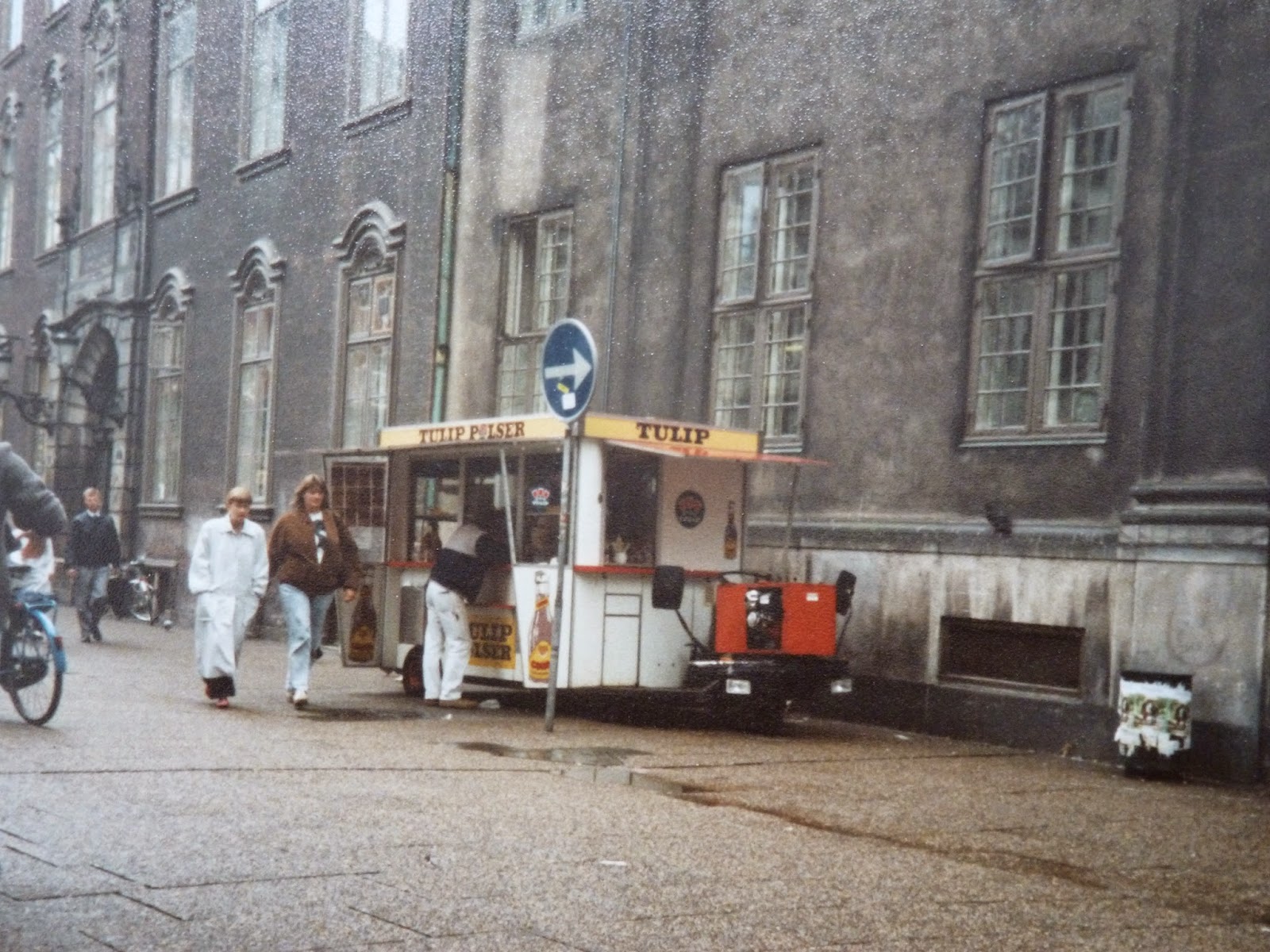
I have only been to Copenhagen once, for a couple of days when I was 17, and my memories of it are no longer that sharp. This is not helped by my only photos of the trip being taken on a bad quality instant camera of the pre-digital era. I was staying with some family friends of my then boyfriend, and the husband gave us a tour of the city which seemed to consist of routes bordering on trespass (“It is a little bit not allowed to drive through here”, as we entered the gates of the Carlsberg brewery) and illegal parking (on the Danish equivalent of a double yellow next to the shore overlooking the Little Mermaid). I ate a pølse from a Tulip snack caravan which is definitely well up there on the list of worst meals of my life and about as far removed from a dinner at Noma that you could possibly get. We went to Tivoli in the evening, where it poured with rain and my boyfriend couldn’t stop farting. Which was possibly linked to the sausages we’d eaten for lunch.
Not Noma

The Danish people I spent most time with lived in South Jutland near the German border, and seemed to have a dislike of Copenhageners (or at least of their accent), so it’s hard to know whether they or the people Hugh was talking to were the more typically Danish, or who these studies of happiness are meant to represent. The people I knew were lovely, gentle folk who could not have been more hospitable, and refused to get even a little bit cross when I managed to crash their car. Blonde? Yes, all of them. Healthy? There was a lot of smoking and beer-drinking going on, and they enjoyed using our customs allowance on runs over the border into Germany to stock up on cheap booze (our reward being a visit to the incredible Nolde museum at Seebull). But their home-cooking (often with produce from the garden) was superb. Happy? Yes, probably. “Content in a very earnest way” is maybe a better way to describe it.

The Danish always struck me as a nation very proud of themselves, but it was a gentle pride that you wanted to share. (Though maybe not some of the older generation's attitudes towards immigrants.) They exhibit a true contentment with themselves and who they are. The Danes have a deep love for their flag, which flutters high in everyone’s gardens, and somehow its red and white colours all their buildings and scenery. But the flag always manages to avoid the imperial or militaristic connotations of a Union Jack or Star-Spangled Banner.

Having visited the city separately and become addicted to The Bridge and The Killing, my husband and I have a current yearning to return to Copenhagen. It seems odd that series about serial killers should have that effect on us. But hyggelig and happy are certainly two things that we strive to be, and my Time Out guide ensures me of the city’s family friendliness (despite our daughter being just a bit too young to be bribed by the promise of the biggest Lego shop in the world). Conveniently, SAS is about to launch direct flights from Leeds Bradford, our nearest airport. But after the sad fate of Marius the giraffe this past weekend, I think we’ll have to give the zoo a miss.
Nyhavn in Copenhagen, made out of Lego